



In brief
Between 59% and 77% of finance functions now use AI, depending on the survey, yet very few report a large return. Gartner finds only 7% see a high impact, and Bain finds only 31% of CFOs are satisfied with their AI outcomes. Budgets keep rising anyway: nearly 60% of CFOs plan to raise finance AI spending by 10% or more. For 2027 the open question is how to measure and govern AI, since nearly every finance team has already adopted it.
The figures come from the major surveys of finance leaders published between mid-2025 and October 2026, and every source was checked again in October 2026. After each set of numbers I add what they mean for a startup or growth company, since the surveys themselves rarely address smaller firms. Most of the samples are large enterprises, and the references give the sample size and company size for each one.
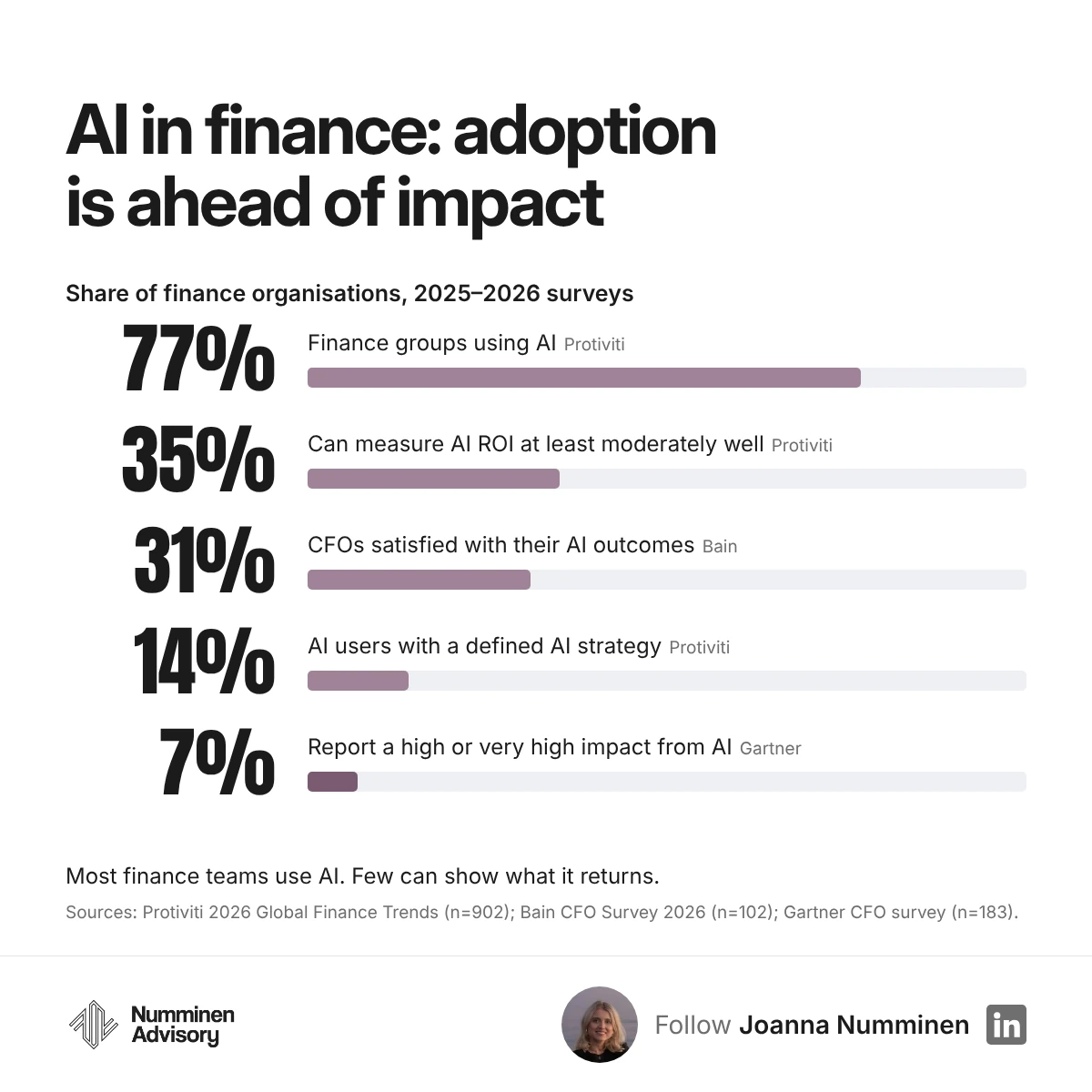
How many finance functions use AI
KPMG reports that active AI use in finance rose from 30% to 75% in two years, in a survey of 1,013 senior finance leaders at companies with revenue of at least US$250 million.1
Protiviti puts the share of finance groups using AI at 77%, but only 14% of those have defined an AI strategy.2
Gartner’s figure is lower and flatter, with 59% of finance leaders using AI in 2025, against 58% in 2024 and 37% in 2023.3
In The CFO Survey run by the Richmond Fed and Duke, nearly 60% of firms invested in AI in 2025 and more than 80% expected to invest in 2026.4
APQC finds that just over half of organisations have implemented or rolled out AI capabilities in finance.5
CFO view. The spread between 59% and 77% says more about how each survey defines “use” than about adoption itself. The figure I find most useful is Protiviti’s 14%: most finance teams are using AI without a plan for it. In a company of 30 people that usually means a few individuals using chat assistants for drafting, with nothing connected to the ledger.
ROI and value
Gartner found that 84% of finance organisations have implemented or plan to implement AI, yet only 7% report a high or very high impact.6
In the KPMG survey, 71% say AI is meeting or exceeding ROI expectations in finance, while only 23% say it is exceeding them.1
In Bain’s 2026 CFO survey, just 31% of CFOs are satisfied with their AI outcomes, rising to over 60% at the most AI-mature firms.7
Bain also finds that CFOs rank speed and cycle-time reduction (48%) ahead of headcount or cost savings (34%) as the main gain from AI in finance.8
Only 35% of finance organisations say they are at least moderately effective at measuring AI ROI, according to Protiviti.2
CFO view. If only a third of finance teams can measure the return, the satisfaction figures are partly guesswork. Bain’s finding on speed matches what I see in practice. The first measurable benefit is usually a shorter close or a faster answer to a board question, and it shows up in days saved well before it shows up in headcount.
Close, reporting and audit
Gartner predicts that finance teams using cloud ERP with embedded AI assistants will see a 30% faster financial close by 2028.9
The same Gartner release forecasts that 62% of cloud ERP spending will go to AI-enabled solutions by 2027, up from 14% in 2024.9
KPMG finds only 42% of organisations are strongly assurance-ready for AI-enabled finance processes, against 60% of agentic AI leaders.1
APQC reports that AI use for financial report generation dipped from 48% to 42% of organisations.5
CFO view. The ERP vendors are building AI into the close whether finance teams ask for it or not, so the practical question for 2027 is whether your auditor will accept what it produces. KPMG’s assurance figure is the one to watch. A reconciliation an agent prepared still needs a documented review that an auditor can follow, and companies facing their first audit should design that review before they switch the tool on.
FP&A and forecasting
Three in four organisations (76%) actively use AI in financial planning, according to KPMG.1
Financial forecasting is the most common AI use case among finance groups using AI, at 76%, ahead of risk assessment (67%) and process automation (56%), according to Protiviti.2
The Hackett Group finds 19% of organisations are already scaling AI for planning and forecasting and another 22% are piloting it. Accounts payable leads, with 33% scaling.10
Bain estimates that roughly 12% of finance organisations have deployed machine learning in FP&A forecasting at full scale.8
CFO view. Between 76% “using” AI in planning and 12% at full scale lies most of the market. For a growth company the forecast rarely fails because of the model. It fails because the actuals feeding it arrive three weeks late or are coded inconsistently, which is why the accounts payable figure from Hackett matters more to me than the forecasting one. Clean transaction data is the precondition for everything in this section.
Agentic AI in finance
KPMG reports that organisations deploying agentic AI see at least 32% stronger performance across key finance metrics.1
In Deloitte’s Finance Trends 2027, 77% of finance leaders are comfortable with agents moving beyond recommendations, yet only 14% would let fully autonomous agents make critical decisions.11
McKinsey finds 40% of large organisations report scaling AI agents, up from 27% a year earlier.12
Bain’s enterprise-wide survey of 951 companies finds only 7% running fully autonomous agents in production.13
In PwC’s AI Agent Survey, 79% of executives say AI agents are being adopted in their companies, while only 34% use them in accounting and finance.14
CFO view. The Deloitte pair of numbers describes how I think agents should work in a finance function today. An agent can match transactions and prepare a first draft. A person approves the payment, signs off the close and decides what the board sees. The 32% performance gap in KPMG’s data is self-reported by large companies, so I would treat it as a direction rather than a promise.
Governance, controls and trust
In a Sage survey run by IDC of 2,275 finance decision makers at companies of about 20 to 1,999 employees, 71% would reject a 99%-accurate tool if it could not explain its answers.15
The same survey finds finance professionals spend nearly 13 hours a week reconstructing, validating and defending AI outputs.15
Workiva reports that 26% of executives say internal audits have detected AI errors that reached external audiences or board members, while 84% are at least somewhat confident in AI output without human review.16
Only 43% of North American CFOs at US$1 billion-plus companies feel confident in their organisation’s AI governance, according to Deloitte’s CFO Signals.17
CFO view. Thirteen hours a week of checking can wipe out the time an AI tool saves. The Workiva figures worry me more, because confidence in unreviewed output is high in the same population where errors are already reaching boards. My rule for clients is simple to state and harder to follow: every AI-prepared number that leaves the finance team has a named reviewer and a trail back to the ledger.
Talent and the CFO role
The Hackett Group finds lack of AI talent is the leading barrier to AI adoption in finance, cited by 77% of organisations.10
Only 36% of CFOs are confident they can drive enterprise AI impact, and 42% that they can hire and retain digital finance talent, according to Gartner.18
Deloitte reports that 54% of finance leaders now own cross-enterprise AI and technology capital allocation.11
ACCA’s Global Talent Trends 2026 survey of 11,389 professionals finds 82% feel confident they can learn and apply AI, while 51% worry about its effect on their jobs.19
CFO view. The talent shortage is real, and it changes the profile of the first finance hire in a small company. Someone who can set up and review automated reconciliations covers more ground than someone who does them by hand. Deloitte’s 54% also shows the CFO is increasingly the person deciding which AI tools the whole company buys, which is a reason to involve finance early in any AI purchase.
Budgets and spend for 2026 and 2027
Nearly 60% of CFOs plan to increase finance AI investment by 10% or more in 2026, though 47% still allocate just 1% to 5% of finance technology spend to AI, according to Gartner.20
Bain finds 83% of CFOs plan to raise enterprise-wide AI spending by more than 15% over two years, and 42% by 30% or more.7
In Deloitte’s survey, 60% of finance leaders expect AI costs and complexity to rise substantially through 2027.11
Finance workloads are projected by The Hackett Group to rise 3.2% in 2026 while headcount falls 2.1% and budgets fall 1.7%, a 5.3% productivity gap.10
Forrester predicted that enterprises would defer a quarter of their planned 2026 AI spend into 2027.21
BCG’s AI Radar shows AI investment as a share of company revenue rising from about 0.6% in 2024 to 0.8% in 2025 and about 1.7% in 2026.22
CFO view. Hackett’s productivity gap explains why budgets rise even while results lag. Finance teams are expected to do more with fewer people, and AI is the only lever left. At startup scale the spend question is smaller and more concrete. Most of the gain comes from AI features already inside the accounting system, the spend tool and the bank feed, so I start by switching those on before buying anything new.
Smaller and mid-market companies
The Duke CFO Survey found 78% of large US companies (500+ employees) invested in AI in 2025, against 48% of small companies, though about 80% of small firms expected to invest in 2026.23
The European Central Bank reports that around 35% of euro area SMEs do not use AI at all, compared with 13% of large firms.24
Protiviti finds 62% of publicly held companies rate their finance AI maturity as Defined or Optimization, against 42% of privately held companies.2
CFO view. Small companies are behind on adoption and catching up fast, and they have one advantage the large-company surveys miss. A company with one or two entities and a modern cloud stack can automate its close in weeks, while a group with legacy ERP takes years. The gap in the Protiviti data between public and private companies is mostly about documentation and controls, which is also what an investor’s diligence team will test.
The counterpoints
Gartner found that 63% of finance organisations said AI implementation was slower than expected in 2025.25
In other Gartner data, 71% of typical finance teams report low impact from their AI investments, and 62% of CFOs say fewer than a quarter of their AI initiatives deliver measurable benefits.26
PwC’s 2026 Global CEO Survey of 4,454 CEOs finds 56% have seen no significant financial benefit from AI to date, and only 12% report both cost and revenue gains.27
Accenture’s Pulse of Change, updated in October 2026, finds 75% of C-suite leaders plan to increase AI investment, yet only 25% report widespread and sustained value.28
CFOs in the Duke survey did not expect AI investment to change headcount much or to produce measurable cost savings in 2026.23
CFO view. Anyone setting a budget needs this side of the evidence as much as the adoption curves. Read together, these findings say the technology works in narrow, well-defined tasks and disappoints when it is bought as a general productivity promise. That is consistent with how we run AI in finance work for clients: one process at a time, with the review step designed first.
Bottom line
AI is now standard in finance functions, and the gap has moved from adoption to results. The companies that report value measure it, govern it and start with clean data. For a startup or growth company, that means fixing the close and the chart of accounts before buying tools, and naming a reviewer for every AI-prepared number. Any figure on this page can be cited with a link back, and each one is traced to its source in the references.
References
KPMG, Global AI in Finance 2026: The Decision Advantage, May 2026. Survey of 1,013 senior finance leaders in 20 countries at companies with revenue of US$250 million or more (US$500 million in the US), March 2026.
Protiviti, 2026 Global Finance Trends Survey Report, 2026. 902 finance executives worldwide, Q2 2026; 21% small, 45% midmarket, 34% large companies.
Gartner, Gartner Survey Shows Finance AI Adoption Remains Steady in 2025, 18 November 2025. 183 CFOs and senior finance leaders, May to June 2025.
Federal Reserve Bank of Richmond, How Might AI Change the Workplace? Evidence From Corporate Executives, 25 March 2026. The CFO Survey, more than 700 executives.
APQC, AI in Finance Benchmarking: From Acceleration to Optimization, 27 July 2026.
Gartner, Gartner Says CFOs Need Structured Finance AI Roadmaps, 8 June 2026. Survey of 183 CFOs, June 2025.
Bain & Company, 42% of CFOs plan to increase AI investment by over 30% within two years, 13 April 2026. More than 100 CFOs globally, half at companies with revenue of US$5 billion or more.
Bain & Company, CFOs Funded the AI Revolution. Now They’re Joining It., 12 April 2026. Bain CFO Survey 2026, n=102.
Gartner, Gartner Predicts Embedded AI in Cloud ERP Applications will Drive a 30% Faster Financial Close by 2028, 24 February 2026. Analyst prediction.
The Hackett Group, The Hackett Group Study Shows AI Adoption Rapidly Accelerating Across Core Finance Processes, 19 March 2026. 2026 Finance Key Issues Study.
Deloitte, Finance Trends 2027, 8 September 2026. 1,434 finance leaders in 26 countries at companies with revenue of US$1 billion or more, spring 2026.
McKinsey & Company, The State of AI in 2026, 25 August 2026. 1,719 participants in 97 countries, May to June 2026.
Bain & Company, Your AI Budget Is Growing. Your Returns Aren’t. Here’s Why., 1 June 2026. Automation and AI Pathfinder Survey 2026, n=951, enterprise-wide.
PwC, How AI agents help drive a new finance operating model, July 2025. PwC AI Agent Survey, US executives.
Sage, Finance leaders demand AI transparency as 71 percent reject unexplained decisions, 6 July 2026. IDC survey of 2,275 finance decision makers at companies of about 20 to 1,999 employees, February 2026.
Workiva, One in four executives say AI errors have reached external audiences, 11 August 2026. 2,272 finance, risk and sustainability professionals plus 367 institutional investors.
Deloitte, Q2 2026 CFO Signals, 23 July 2026. 200 CFOs at North American companies with revenue of US$1 billion or more.
Gartner, Gartner Survey Shows Top Priorities for CFOs in 2026, December 2025. More than 200 CFOs, August 2025.
ACCA, Global Talent Trends 2026, executive summary, 2026. 11,389 respondents in 160 countries, October 2025 to February 2026.
Gartner, Gartner Research Reveals CFOs’ Budget Plans Prioritize Growth Functions, Technology and AI in 2026, 10 February 2026. More than 300 CFOs and finance leaders, October 2025.
Forrester, Forrester’s 2026 Technology & Security Predictions, 28 October 2025. Analyst prediction.
BCG, AI Radar 2026: As AI Investments Surge, CEOs Take the Lead, January 2026. 2,360 respondents in 16 markets, enterprise-wide.
Duke University Fuqua School of Business, CFO outlook for 2026: tariffs, hiring, prices, AI impact, 17 December 2025. 548 respondents, November 2025.
European Central Bank, Adoption and investment in AI across the euro area, Occasional Paper No 395, 2026. About 6,000 non-financial firms in 12 euro area countries.
Gartner, Gartner Says CFOs Must Stop Mistaking Finance AI Deployment for Value Creation, 28 May 2026. 204 finance leaders, March 2026.
Gartner, Gartner Says CFOs Risk Falling Behind Without a Scalable AI Strategy, 27 May 2026.
PwC, 29th Annual Global CEO Survey, 19 January 2026. 4,454 CEOs in 95 countries and territories.
Accenture, Pulse of Change, updated 19 October 2026. 3,000 C-suite leaders at companies with revenue above US$300 million, July to August 2026.