
Category: Insights

  • Numminen rune numeral 12 (jera)

    Financial due diligence checklist for a Series A or B tech company

    Most checklists for financial due diligence are written for acquisitions, where a buyer’s accountants spend weeks inside a mature company. A Series A or B round is different. The investor’s team is smaller, the timeline is shorter, and the question they are answering is narrower: can the numbers in the pitch be traced back to the ledger, and will they still hold when the company is twice the size?
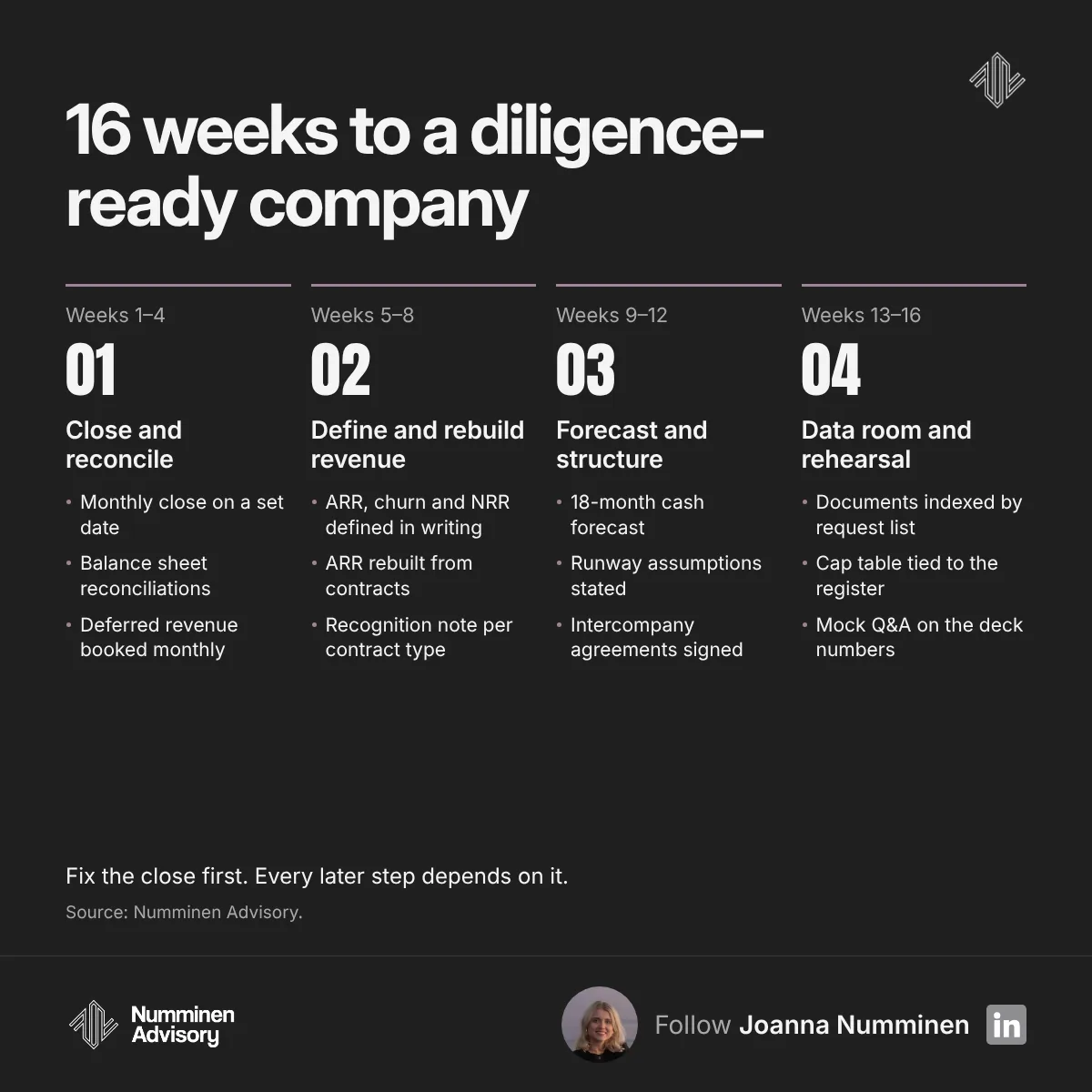
    16 weeks to a diligence-ready company. Fix the close first. Every later step depends on it.
    Source: Numminen Advisory.

    I have prepared companies for venture capital due diligence and for an acquirer’s financial due diligence, and the specifics are best discussed in confidence, so get in touch if you want to hear how it went in practice. What follows is the preparation I ask founders to start four months before a round.

    What investors are really testing

    Diligence in a funding round is rarely an audit. Nobody re-performs your bookkeeping. The investor’s finance team, or an outside firm working for them, picks a handful of numbers from your deck and asks you to show where each one comes from. Annual recurring revenue, gross margin, burn and runway are the usual candidates.

    When the answer is a reconciled report out of the accounting system, the questions move on quickly. When it is a spreadsheet that only one person understands, the questions multiply, and the term sheet timeline starts to slip.

    The checklist

    The same list comes as a working file with owner, status and data room columns, either as a Google Sheet you can copy or as an Excel download. Use it to track who prepares each item and where it sits in the data room.

    1. Historical accounts and the monthly close

    • Annual accounts for the last two or three financial years, with the auditor’s report where one exists.

    • Monthly management accounts for the last 12 to 24 months, built from the same ledger as the annual accounts.

    • A monthly close that finishes on a set date, ideally within ten working days of month end.

    • Balance sheet reconciliations for cash, receivables, payables, accruals and deferred revenue, signed off each month.

    • A short note on any restatements, unusual items or one-off costs, with the reason for each.

    2. Revenue and its definitions

    • A written definition of every revenue metric in the deck, including ARR, MRR, bookings, net revenue retention and churn.

    • ARR rebuilt customer by customer from signed contracts, reconciling to recognised revenue in the ledger.

    • A revenue recognition note for each contract type, covering subscriptions, implementation fees, usage-based charges and multi-year deals.

    • The share of revenue coming from the top five and top ten customers.

    • Cohort data showing retention and expansion over time, built from billing data that ties to the ledger.

    3. Cash, burn and the forecast

    • A monthly cash forecast for at least 18 months, starting from the actual bank balance.

    • Burn rate and runway, with the two or three assumptions they depend on stated in writing.

    • The hiring plan behind the forecast, by month and role.

    • A scenario that shows what happens if the round closes three months later than planned.

    4. Group structure and intercompany

    • A legal structure chart showing every entity, its country, its ownership and what it holds: employees, IP, contracts and cash.

    • Signed intercompany agreements for services, licences and loans, with pricing that matches what is booked.

    • Transfer pricing documentation, or a clear note on why the group is below the documentation threshold.

    • Consolidated figures for the group, with eliminations shown, if the deck presents group numbers.

    5. Tax, grants and public funding

    • Corporate income tax and VAT filings for each entity, with any correspondence from tax authorities.

    • Grant and loan agreements from Business Finland, the EU or other public funders, including repayment and reporting conditions.

    • A written policy on capitalising development costs, applied the same way every year.

    • Any open tax positions or disputes, with an estimate of exposure.

    6. Ownership, contracts and commitments

    • A cap table that ties to the official share register, including all option grants and convertible instruments.

    • The option plan documents and every grant letter.

    • The top 20 customer and supplier contracts, with change-of-control and exclusivity clauses flagged.

    • Debt, leases and other commitments, with covenant terms summarised.

    When to start

    Four months before the first investor meeting is about right for a company with one entity and a working monthly close. Add time for each additional entity and each accounting framework the group reports under, because consolidation and intercompany questions take the longest to answer well.

    The order matters. Fix the close and the reconciliations first, since every later step depends on them. Then write the revenue definitions and rebuild ARR from contracts. Build the forecast on top of clean actuals. Assemble the data room last, once the documents in it can be trusted.

    The findings that slow rounds down

    Five issues come up again and again when I review a company before a raise.

    ARR that does not reconcile. The deck figure was built from the CRM and nobody has tied it to recognised revenue. The fix is a customer-level bridge between the two, updated monthly.

    Deferred revenue that only exists in a spreadsheet. Annual prepayments are booked as revenue on invoice, and the adjustment is made by hand at year end. Investors will ask for the monthly view.

    Intercompany balances that do not match. The Finnish parent shows a receivable from the US subsidiary that differs from the payable on the other side. Each mismatch raises a question about whether the consolidated numbers can be trusted.

    Grant conditions nobody has read. Public funding often carries reporting duties, cost eligibility rules and, in some cases, repayment conditions linked to ownership changes. An investor needs to know before they invest.

    A cap table that disagrees with the register. Small differences in option grants or share classes take lawyers’ time to resolve, and they surface late.

    Where AI helps, and where it does not

    Much of diligence preparation is matching: each investor request against the documents in the data room, each intercompany line against its counterpart, each ARR line against a contract. At Numminen Advisory this is work that AI agents now prepare, checking requests against the data room index and drafting a first answer from the ledger. What gets released to an investor, and how a finding is explained, stays with the CFO.

    Bottom line

    A Series A or B diligence goes well when every number in the deck can be traced to the ledger in minutes. Start four months ahead, fix the close before anything else, and write down your definitions before an investor asks for them. If a round is on the horizon, our funding and diligence readiness work starts with a review of exactly this list.

  • Numminen rune numeral 11 (isaz)

    What fractional and interim CFOs cost in Europe in 2026

    Founders comparing options often find prices quoted per hour, per day, per month and per year. Converted to the same unit, the options become comparable, and surveys with a stated sample are the most reliable starting point. The research covers three markets. This English edition looks at Europe as a whole, and our Finnish and Polish editions go deeper into the two markets where we work most.

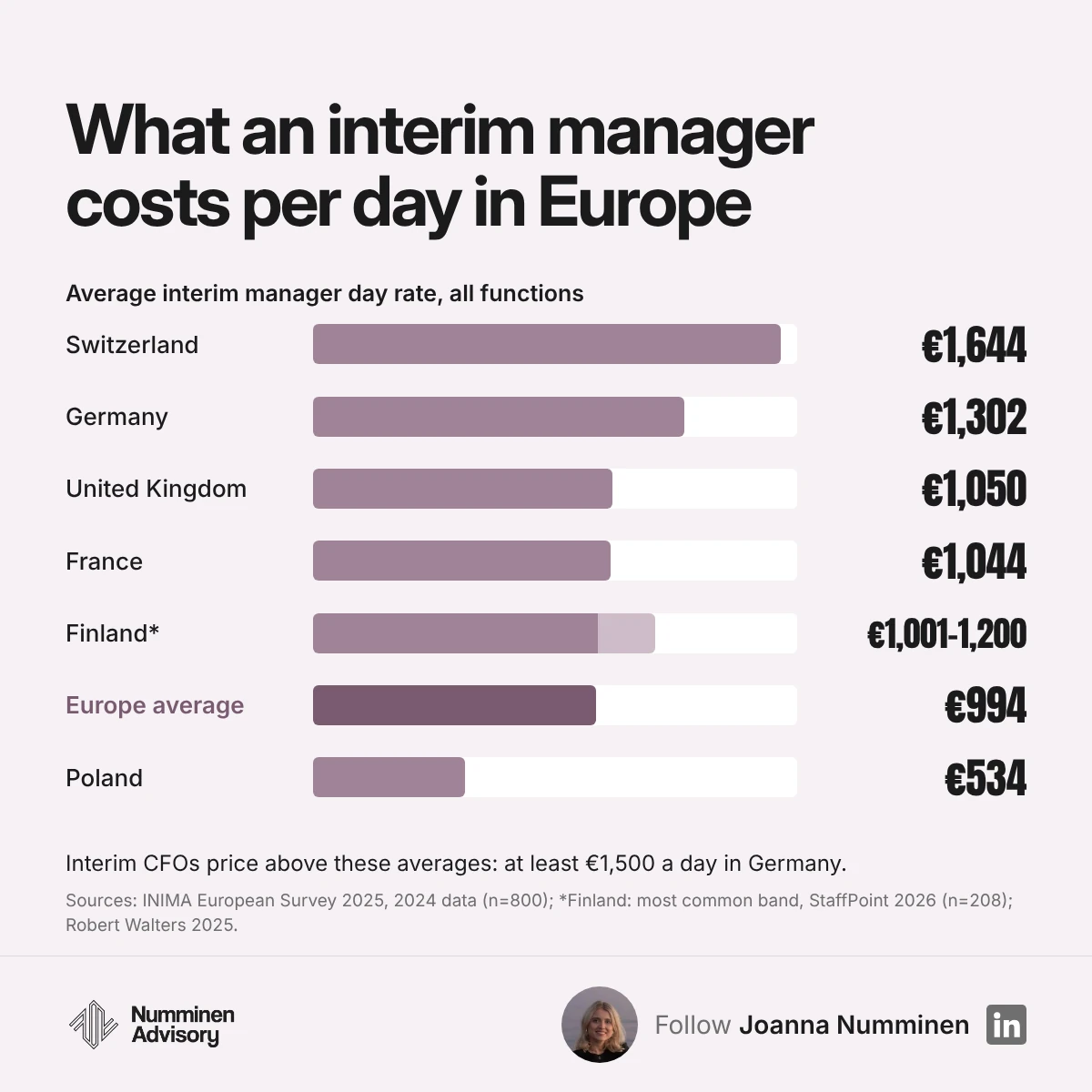
    What an interim manager costs per day in Europe. Average interim manager day rate, all functions.
    Sources: INIMA European Survey 2025, 2024 data (n=800); *Finland: most common band, StaffPoint 2026 (n=208); Robert Walters 2025.

    Fractional and interim: two different purchases

    An interim CFO fills a seat full-time or close to it, usually for three to twelve months, often after a CFO leaves or during a transaction. The price is a day rate multiplied by the days worked.

    A fractional CFO works a set number of days a month on an ongoing basis, alongside an accounting firm or a small internal team. The price is a monthly retainer. Per day, a retainer usually costs more than the same person’s interim rate, because it also pays for availability between the planned days: a question from the founder, a board paper that cannot wait, an investor call that comes up mid-month.

    Most of the published survey data covers interim day rates. Retainer prices are less well documented, so the fractional prices further down are derived from the day rates.

    Interim day rates by country

    The most consistent cross-country source is the INIMA European Interim Manager Survey, which collects day rates from members of national interim management associations. Its 2025 edition, covering 2024, gives the following averages across all functions.1

    Country Average interim day rate, 2024 (all functions)
    Switzerland €1,644
    Germany €1,302
    United Kingdom €1,050
    France €1,044
    European average €994
    Poland €534

    The 2026 edition reports that the European average fell by €9 to €985 a day in 2025.2 The 2025 edition has no data for Finland, the Netherlands or the other Nordic countries, so the Finnish figure comes from a national survey.

    Finland. StaffPoint’s 2026 market review of 208 respondents found that interim managers most commonly bill €1,001 to €1,200 a day, and that over half of all interim professionals bill €1,000 or less. One in four bills more than €1,200. StaffPoint also notes that interim fees have not risen and in places have moved down.3

    Poland. At €534 a day in the INIMA data, Polish interim rates are roughly half the European average, with the Polish figures supplied by the national interim association SIM.1

    What a CFO adds to the average

    The averages above cover every function, from HR to operations. Finance leadership sits higher. Robert Walters’ 2025 interim study, which surveyed about 1,300 interim professionals across Europe including 174 in Germany, reports that interim CFOs command a minimum of €1,500 a day and that finance directors typically start at €1,400.4

    In the UK, the Institute of Interim Management’s 2026 survey puts the average private-sector interim day rate at £1,004, against £700 in the public sector.5 The IIM does not break its figures down by function.

    The German interim association DDIM gives a reason to read every quoted day rate carefully. When an interim manager is placed through a provider, the provider typically takes 25 to 35 per cent of the agreed day rate.6 Two quotes for the same day rate can therefore pay the person doing the work quite different amounts.

    What a fractional CFO costs

    Retainers are quoted per month, usually for a fixed number of days. Finance leadership prices above the all-function averages, so the fairer basis is the CFO-level rate. At the Robert Walters minimum of €1,500 a day for an interim CFO, two days a month cost about €3,000, four days about €6,000 and seven days about €10,500. The Finnish all-function band of €1,001 to €1,200 would put two to four days at roughly €2,000 to €4,800, but that band covers every function, not CFO work.

    Three things move a quote up or down:

    • Scope. A retainer that includes board reporting and a funding round needs more days than one that reviews the monthly close.

    • Group complexity. Each additional entity, currency and reporting framework adds consolidation and intercompany work.

    • Seniority and track record. CFOs who have taken companies through a funding round, an audit or an exit charge more for it.

    We publish our own fees so they can be compared directly. A fractional CFO retainer with us costs €3,500 a month for two days, €6,500 for four days and €10,500 for seven, and our interim day rate starts from €1,450, all excluding VAT. Per day that is €1,750, €1,625 and €1,500, falling as the retainer grows. The pricing page sets out what each retainer includes.

    The comparison with a full-time CFO

    A full-time CFO is a salary plus employer costs, paid every month whether the work is there or not. Official statistics give a reference point in two Nordic markets.

    • In Finland, the average monthly salary for a talousjohtaja in the private sector was €9,823 in 2024, based on 1,069 salaries in Statistics Finland’s wage data, as reported by Duunitori.7 Employer contributions come on top.

    • In Sweden, Statistics Sweden puts the average monthly salary for top-level finance managers at SEK 87,400 before tax.8

    For a company that needs CFO judgement two to four days a month, a retainer costs a fraction of either figure. The comparison changes once the work fills most of the week, which is usually the point to recruit.

    Where the data is thin

    There is no survey with a stated sample for interim or fractional CFO rates in the Netherlands, Sweden, Denmark or Norway. Ranges circulating for those markets come from vendors and recruiters without a published method, so we have left them out. The INIMA figures are also all-function averages, so a CFO assignment in any of those countries will usually price above them.

    Bottom line

    Across Europe, interim managers bill about €985 a day on average, from around €530 in Poland to over €1,600 in Switzerland, and interim CFOs sit above that. At CFO-level day rates, a fractional retainer of two to seven days a month works out at roughly €3,000 to €10,500, with scope and group complexity deciding where in that range a quote lands. Compare quotes on the same unit, ask what the day rate pays the person doing the work, and check what is included before comparing totals.

    References

    1. INIMA, European Interim Manager Survey 2025, March 2025. 800 interim managers who are members of national interim associations in eleven countries; data for 2024; all functions.

    2. INIMA, European Interim Manager Survey 2026, May 2026. About 850 responses from ten national markets; data for 2025.

    3. StaffPoint, Interim management market review 2026 (press release, in Finnish), 11 March 2026. 208 respondents, interim professionals and companies, surveyed late 2025.

    4. Robert Walters, Interim professionals increased their rates, 15 April 2025. About 1,300 interim professionals across Europe, 174 in Germany.

    5. Institute of Interim Management, Interim Management Survey 2026, June 2026.

    6. DDIM, Honorare im Interim Management (in German), updated April 2023.

    7. Duunitori, Talousjohtaja palkka (in Finnish), based on Statistics Finland wage structure data for 2024.

    8. Statistics Sweden, Lönesök: Ekonomi- och finanschefer (in Swedish).

  • Numminen rune numeral 10 (naudiz)

    Controller vs CFO: who to hire first when you outgrow your accounting firm

    Most startups in Finland and the rest of Europe start the same way. An accounting firm keeps the books, runs payroll and files VAT, and the founder handles everything else in finance. It works well for a single entity with simple revenue. It stops working when the company raises institutional money, opens a subsidiary abroad, or signs customers on contracts that the accounting firm was never set up to interpret.

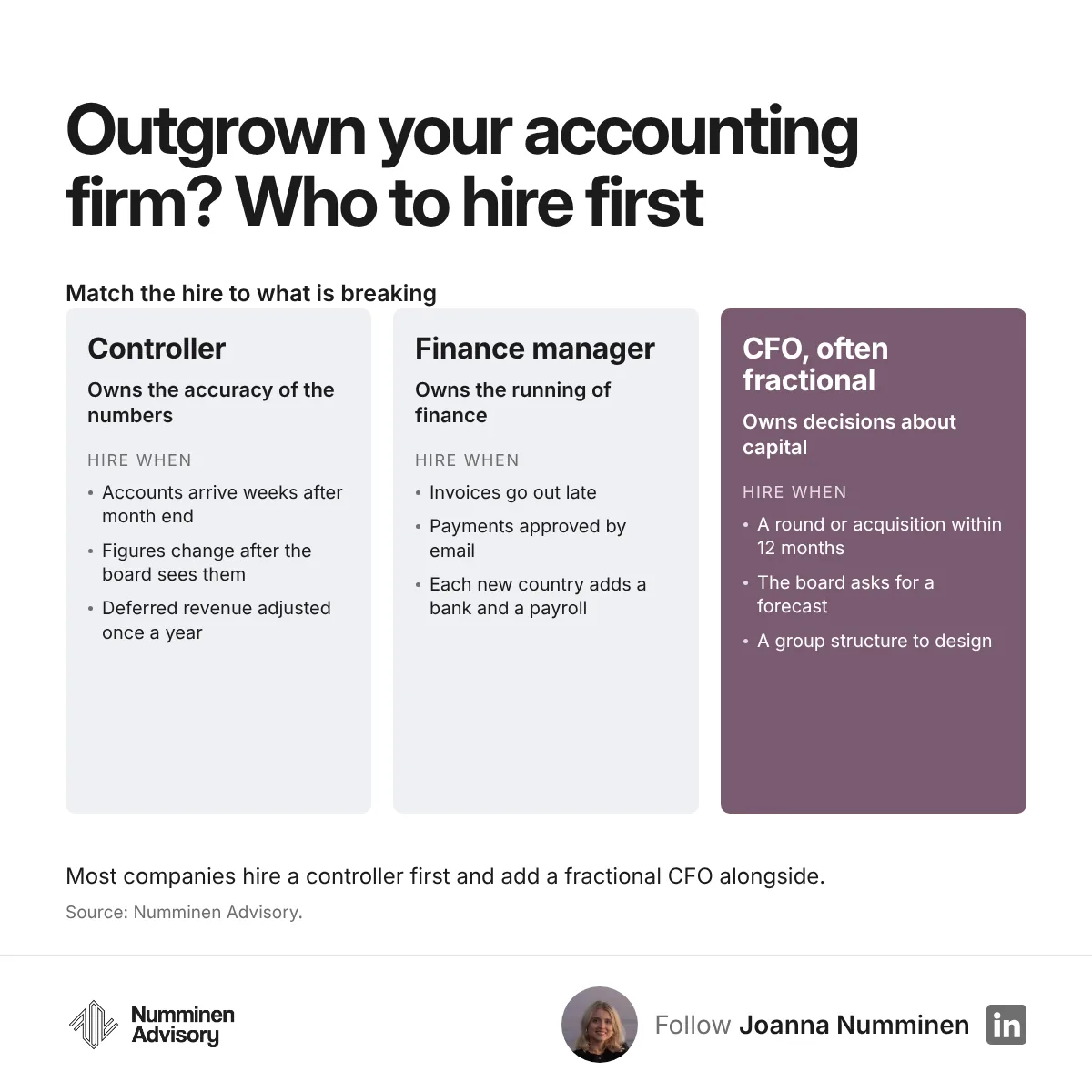
    Outgrown your accounting firm? Who to hire first. Match the hire to what is breaking.
    Source: Numminen Advisory.

    At that point the question becomes who to hire first. The answer depends on which part of the finance function is failing, and it is rarely the same for two companies.

    Three roles that often get confused

    The titles overlap, and in Finnish companies talouspäällikkö, controller and talousjohtaja are sometimes used for the same job. It helps to define them by what each one owns.

    A controller owns the accuracy of the numbers. The monthly close, balance sheet reconciliations, accruals and deferred revenue, the chart of accounts and the internal controls around payments. A controller looks backwards and makes sure the books are right.

    A finance manager owns the running of finance. Supplier invoices and payments, customer invoicing and collections, payroll inputs, expense policy, and the working relationship with the accounting firm and the bank. In a growing group this often includes keeping two or three entities’ administration in step.

    A CFO owns decisions about capital. Where funding comes from and what it costs, how long the cash lasts, how the group is structured, what investors and the board see, and what has to be true before the next round or transaction. A CFO looks forward.

    What breaks first when you outgrow the accounting firm

    The symptoms are usually visible months before anyone names them. Matching the symptom to the role is the most reliable way to decide.

    What you are seeing What is missing Who fixes it
    Management accounts arrive three or four weeks after month end, and the numbers change after the board has seen them A monthly close owned inside the company Controller
    Deferred revenue, accruals and intercompany balances are adjusted once a year Reconciliations and revenue accounting Controller
    Invoices go out late, suppliers chase payments and nobody owns the bank portal Day-to-day finance operations Finance manager
    A second or third entity has its own accounting firm and nobody joins the pieces up Group administration Finance manager, with a controller for consolidation
    A funding round, debt facility or acquisition is planned within twelve months Capital decisions and investor readiness CFO, often fractional
    The board asks for a forecast and the founder builds it alone at night Planning and runway ownership CFO, often fractional

    Why the controller usually comes first

    For a company leaving the accounting firm model, the controller is the most common first hire. Hire a CFO into a function without a reliable monthly close, and they spend the first months doing controller work at CFO cost. The wider sequence, from bookkeeping to FP&A, is covered in the order you build a finance function.

    The accounting firm keeps the bookkeeping, payroll processing and statutory filings, often for years. What moves inside is ownership of the close and of how transactions are classified.

    When a finance manager makes more sense

    A finance manager is the better first hire when the books are broadly right but the operations around them are not. This is common in companies that grew quickly through sales, where invoicing lags behind and each new country adds a bank and a payroll provider. Payments are often still approved by email. Bringing order to that work also frees the founder’s time.

    In a small team the two roles often merge into one person, a financial controller, who runs the operations and owns the close. The combination works well up to a point. Once there are several entities, more than one reporting framework or an audit to prepare for, the close work tends to crowd out everything else.

    Where a CFO fits

    A full-time CFO is a late hire for most startups. The decisions that need one arrive in bursts: a round, a new subsidiary, a first audit, a transaction. Between those events, the work of a CFO amounts to a few days a month. That is why many growth companies pair an internal controller or finance manager with a fractional CFO who owns the forecast, the board reporting and the funding work.

    The triggers that call for a CFO are structural, not a revenue figure. A company with one entity and simple subscription revenue can grow a long way with a controller and a good accounting firm. A smaller company with three entities, public funding and investors asking for IFRS reporting usually cannot.

    How AI changes the first hire

    AI tools now prepare much of the routine work in a finance function, such as matching bank transactions, coding supplier invoices and drafting variance commentary. In practice that changes the profile of the first hire more than the number of hires. Someone who can set up and review automated reconciliations covers more ground than a person who does them by hand, and a small team can support a larger group. The judgement about what gets booked and what the board is told stays with people.

    Bottom line

    When you outgrow your accounting firm, look at what is failing before you write the job description. Late or unreliable numbers call for a controller. Chaotic day-to-day operations call for a finance manager. Decisions about capital call for a CFO, and at startup scale that is usually a fractional one working alongside the first internal hire. If you are unsure which applies, request an intro call and we will tell you, including when the answer is a controller rather than us.

  • Numminen rune numeral 9 (hagalaz)

    AI in finance statistics for 2027

    The figures come from the major surveys of finance leaders published between mid-2025 and October 2026, and every source was checked again in October 2026. After each set of numbers I add what they mean for a startup or growth company, since the surveys themselves rarely address smaller firms. Most of the samples are large enterprises, and the references give the sample size and company size for each one.

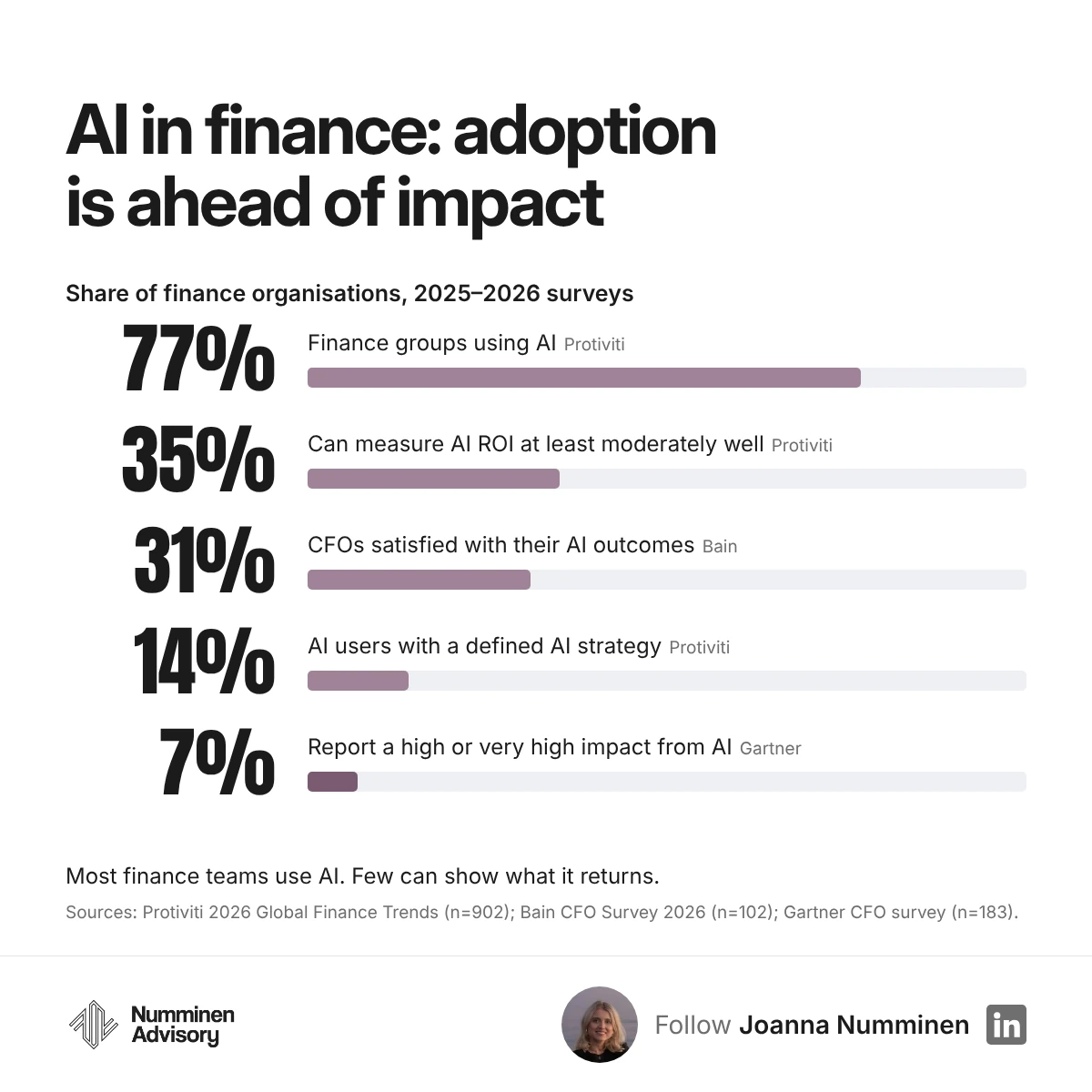
    AI in finance: adoption is ahead of impact. Share of finance organisations, 2025–2026 surveys.
    Sources: Protiviti 2026 Global Finance Trends (n=902); Bain CFO Survey 2026 (n=102); Gartner CFO survey (n=183).

    How many finance functions use AI

    • KPMG reports that active AI use in finance rose from 30% to 75% in two years, in a survey of 1,013 senior finance leaders at companies with revenue of at least US$250 million.1

    • Protiviti puts the share of finance groups using AI at 77%, but only 14% of those have defined an AI strategy.2

    • Gartner’s figure is lower and flatter, with 59% of finance leaders using AI in 2025, against 58% in 2024 and 37% in 2023.3

    • In The CFO Survey run by the Richmond Fed and Duke, nearly 60% of firms invested in AI in 2025 and more than 80% expected to invest in 2026.4

    • APQC finds that just over half of organisations have implemented or rolled out AI capabilities in finance.5

    CFO view. The spread between 59% and 77% says more about how each survey defines “use” than about adoption itself. The figure I find most useful is Protiviti’s 14%: most finance teams are using AI without a plan for it. In a company of 30 people that usually means a few individuals using chat assistants for drafting, with nothing connected to the ledger.

    ROI and value

    • Gartner found that 84% of finance organisations have implemented or plan to implement AI, yet only 7% report a high or very high impact.6

    • In the KPMG survey, 71% say AI is meeting or exceeding ROI expectations in finance, while only 23% say it is exceeding them.1

    • In Bain’s 2026 CFO survey, just 31% of CFOs are satisfied with their AI outcomes, rising to over 60% at the most AI-mature firms.7

    • Bain also finds that CFOs rank speed and cycle-time reduction (48%) ahead of headcount or cost savings (34%) as the main gain from AI in finance.8

    • Only 35% of finance organisations say they are at least moderately effective at measuring AI ROI, according to Protiviti.2

    CFO view. If only a third of finance teams can measure the return, the satisfaction figures are partly guesswork. Bain’s finding on speed matches what I see in practice. The first measurable benefit is usually a shorter close or a faster answer to a board question, and it shows up in days saved well before it shows up in headcount.

    Close, reporting and audit

    • Gartner predicts that finance teams using cloud ERP with embedded AI assistants will see a 30% faster financial close by 2028.9

    • The same Gartner release forecasts that 62% of cloud ERP spending will go to AI-enabled solutions by 2027, up from 14% in 2024.9

    • KPMG finds only 42% of organisations are strongly assurance-ready for AI-enabled finance processes, against 60% of agentic AI leaders.1

    • APQC reports that AI use for financial report generation dipped from 48% to 42% of organisations.5

    CFO view. The ERP vendors are building AI into the close whether finance teams ask for it or not, so the practical question for 2027 is whether your auditor will accept what it produces. KPMG’s assurance figure is the one to watch. A reconciliation an agent prepared still needs a documented review that an auditor can follow, and companies facing their first audit should design that review before they switch the tool on.

    FP&A and forecasting

    • Three in four organisations (76%) actively use AI in financial planning, according to KPMG.1

    • Financial forecasting is the most common AI use case among finance groups using AI, at 76%, ahead of risk assessment (67%) and process automation (56%), according to Protiviti.2

    • The Hackett Group finds 19% of organisations are already scaling AI for planning and forecasting and another 22% are piloting it. Accounts payable leads, with 33% scaling.10

    • Bain estimates that roughly 12% of finance organisations have deployed machine learning in FP&A forecasting at full scale.8

    CFO view. Between 76% “using” AI in planning and 12% at full scale lies most of the market. For a growth company the forecast rarely fails because of the model. It fails because the actuals feeding it arrive three weeks late or are coded inconsistently, which is why the accounts payable figure from Hackett matters more to me than the forecasting one. Clean transaction data is the precondition for everything in this section.

    Agentic AI in finance

    • KPMG reports that organisations deploying agentic AI see at least 32% stronger performance across key finance metrics.1

    • In Deloitte’s Finance Trends 2027, 77% of finance leaders are comfortable with agents moving beyond recommendations, yet only 14% would let fully autonomous agents make critical decisions.11

    • McKinsey finds 40% of large organisations report scaling AI agents, up from 27% a year earlier.12

    • Bain’s enterprise-wide survey of 951 companies finds only 7% running fully autonomous agents in production.13

    • In PwC’s AI Agent Survey, 79% of executives say AI agents are being adopted in their companies, while only 34% use them in accounting and finance.14

    CFO view. The Deloitte pair of numbers describes how I think agents should work in a finance function today. An agent can match transactions and prepare a first draft. A person approves the payment, signs off the close and decides what the board sees. The 32% performance gap in KPMG’s data is self-reported by large companies, so I would treat it as a direction rather than a promise.

    Governance, controls and trust

    • In a Sage survey run by IDC of 2,275 finance decision makers at companies of about 20 to 1,999 employees, 71% would reject a 99%-accurate tool if it could not explain its answers.15

    • The same survey finds finance professionals spend nearly 13 hours a week reconstructing, validating and defending AI outputs.15

    • Workiva reports that 26% of executives say internal audits have detected AI errors that reached external audiences or board members, while 84% are at least somewhat confident in AI output without human review.16

    • Only 43% of North American CFOs at US$1 billion-plus companies feel confident in their organisation’s AI governance, according to Deloitte’s CFO Signals.17

    CFO view. Thirteen hours a week of checking can wipe out the time an AI tool saves. The Workiva figures worry me more, because confidence in unreviewed output is high in the same population where errors are already reaching boards. My rule for clients is simple to state and harder to follow: every AI-prepared number that leaves the finance team has a named reviewer and a trail back to the ledger.

    Talent and the CFO role

    • The Hackett Group finds lack of AI talent is the leading barrier to AI adoption in finance, cited by 77% of organisations.10

    • Only 36% of CFOs are confident they can drive enterprise AI impact, and 42% that they can hire and retain digital finance talent, according to Gartner.18

    • Deloitte reports that 54% of finance leaders now own cross-enterprise AI and technology capital allocation.11

    • ACCA’s Global Talent Trends 2026 survey of 11,389 professionals finds 82% feel confident they can learn and apply AI, while 51% worry about its effect on their jobs.19

    CFO view. The talent shortage is real, and it changes the profile of the first finance hire in a small company. Someone who can set up and review automated reconciliations covers more ground than someone who does them by hand. Deloitte’s 54% also shows the CFO is increasingly the person deciding which AI tools the whole company buys, which is a reason to involve finance early in any AI purchase.

    Budgets and spend for 2026 and 2027

    • Nearly 60% of CFOs plan to increase finance AI investment by 10% or more in 2026, though 47% still allocate just 1% to 5% of finance technology spend to AI, according to Gartner.20

    • Bain finds 83% of CFOs plan to raise enterprise-wide AI spending by more than 15% over two years, and 42% by 30% or more.7

    • In Deloitte’s survey, 60% of finance leaders expect AI costs and complexity to rise substantially through 2027.11

    • Finance workloads are projected by The Hackett Group to rise 3.2% in 2026 while headcount falls 2.1% and budgets fall 1.7%, a 5.3% productivity gap.10

    • Forrester predicted that enterprises would defer a quarter of their planned 2026 AI spend into 2027.21

    • BCG’s AI Radar shows AI investment as a share of company revenue rising from about 0.6% in 2024 to 0.8% in 2025 and about 1.7% in 2026.22

    CFO view. Hackett’s productivity gap explains why budgets rise even while results lag. Finance teams are expected to do more with fewer people, and AI is the only lever left. At startup scale the spend question is smaller and more concrete. Most of the gain comes from AI features already inside the accounting system, the spend tool and the bank feed, so I start by switching those on before buying anything new.

    Smaller and mid-market companies

    • The Duke CFO Survey found 78% of large US companies (500+ employees) invested in AI in 2025, against 48% of small companies, though about 80% of small firms expected to invest in 2026.23

    • The European Central Bank reports that around 35% of euro area SMEs do not use AI at all, compared with 13% of large firms.24

    • Protiviti finds 62% of publicly held companies rate their finance AI maturity as Defined or Optimization, against 42% of privately held companies.2

    CFO view. Small companies are behind on adoption and catching up fast, and they have one advantage the large-company surveys miss. A company with one or two entities and a modern cloud stack can automate its close in weeks, while a group with legacy ERP takes years. The gap in the Protiviti data between public and private companies is mostly about documentation and controls, which is also what an investor’s diligence team will test.

    The counterpoints

    • Gartner found that 63% of finance organisations said AI implementation was slower than expected in 2025.25

    • In other Gartner data, 71% of typical finance teams report low impact from their AI investments, and 62% of CFOs say fewer than a quarter of their AI initiatives deliver measurable benefits.26

    • PwC’s 2026 Global CEO Survey of 4,454 CEOs finds 56% have seen no significant financial benefit from AI to date, and only 12% report both cost and revenue gains.27

    • Accenture’s Pulse of Change, updated in October 2026, finds 75% of C-suite leaders plan to increase AI investment, yet only 25% report widespread and sustained value.28

    • CFOs in the Duke survey did not expect AI investment to change headcount much or to produce measurable cost savings in 2026.23

    CFO view. Anyone setting a budget needs this side of the evidence as much as the adoption curves. Read together, these findings say the technology works in narrow, well-defined tasks and disappoints when it is bought as a general productivity promise. That is consistent with how we run AI in finance work for clients: one process at a time, with the review step designed first.

    Bottom line

    AI is now standard in finance functions, and the gap has moved from adoption to results. The companies that report value measure it, govern it and start with clean data. For a startup or growth company, that means fixing the close and the chart of accounts before buying tools, and naming a reviewer for every AI-prepared number. Any figure on this page can be cited with a link back, and each one is traced to its source in the references.

    References

    1. KPMG, Global AI in Finance 2026: The Decision Advantage, May 2026. Survey of 1,013 senior finance leaders in 20 countries at companies with revenue of US$250 million or more (US$500 million in the US), March 2026.

    2. Protiviti, 2026 Global Finance Trends Survey Report, 2026. 902 finance executives worldwide, Q2 2026; 21% small, 45% midmarket, 34% large companies.

    3. Gartner, Gartner Survey Shows Finance AI Adoption Remains Steady in 2025, 18 November 2025. 183 CFOs and senior finance leaders, May to June 2025.

    4. Federal Reserve Bank of Richmond, How Might AI Change the Workplace? Evidence From Corporate Executives, 25 March 2026. The CFO Survey, more than 700 executives.

    5. APQC, AI in Finance Benchmarking: From Acceleration to Optimization, 27 July 2026.

    6. Gartner, Gartner Says CFOs Need Structured Finance AI Roadmaps, 8 June 2026. Survey of 183 CFOs, June 2025.

    7. Bain & Company, 42% of CFOs plan to increase AI investment by over 30% within two years, 13 April 2026. More than 100 CFOs globally, half at companies with revenue of US$5 billion or more.

    8. Bain & Company, CFOs Funded the AI Revolution. Now They’re Joining It., 12 April 2026. Bain CFO Survey 2026, n=102.

    9. Gartner, Gartner Predicts Embedded AI in Cloud ERP Applications will Drive a 30% Faster Financial Close by 2028, 24 February 2026. Analyst prediction.

    10. The Hackett Group, The Hackett Group Study Shows AI Adoption Rapidly Accelerating Across Core Finance Processes, 19 March 2026. 2026 Finance Key Issues Study.

    11. Deloitte, Finance Trends 2027, 8 September 2026. 1,434 finance leaders in 26 countries at companies with revenue of US$1 billion or more, spring 2026.

    12. McKinsey & Company, The State of AI in 2026, 25 August 2026. 1,719 participants in 97 countries, May to June 2026.

    13. Bain & Company, Your AI Budget Is Growing. Your Returns Aren’t. Here’s Why., 1 June 2026. Automation and AI Pathfinder Survey 2026, n=951, enterprise-wide.

    14. PwC, How AI agents help drive a new finance operating model, July 2025. PwC AI Agent Survey, US executives.

    15. Sage, Finance leaders demand AI transparency as 71 percent reject unexplained decisions, 6 July 2026. IDC survey of 2,275 finance decision makers at companies of about 20 to 1,999 employees, February 2026.

    16. Workiva, One in four executives say AI errors have reached external audiences, 11 August 2026. 2,272 finance, risk and sustainability professionals plus 367 institutional investors.

    17. Deloitte, Q2 2026 CFO Signals, 23 July 2026. 200 CFOs at North American companies with revenue of US$1 billion or more.

    18. Gartner, Gartner Survey Shows Top Priorities for CFOs in 2026, December 2025. More than 200 CFOs, August 2025.

    19. ACCA, Global Talent Trends 2026, executive summary, 2026. 11,389 respondents in 160 countries, October 2025 to February 2026.

    20. Gartner, Gartner Research Reveals CFOs’ Budget Plans Prioritize Growth Functions, Technology and AI in 2026, 10 February 2026. More than 300 CFOs and finance leaders, October 2025.

    21. Forrester, Forrester’s 2026 Technology & Security Predictions, 28 October 2025. Analyst prediction.

    22. BCG, AI Radar 2026: As AI Investments Surge, CEOs Take the Lead, January 2026. 2,360 respondents in 16 markets, enterprise-wide.

    23. Duke University Fuqua School of Business, CFO outlook for 2026: tariffs, hiring, prices, AI impact, 17 December 2025. 548 respondents, November 2025.

    24. European Central Bank, Adoption and investment in AI across the euro area, Occasional Paper No 395, 2026. About 6,000 non-financial firms in 12 euro area countries.

    25. Gartner, Gartner Says CFOs Must Stop Mistaking Finance AI Deployment for Value Creation, 28 May 2026. 204 finance leaders, March 2026.

    26. Gartner, Gartner Says CFOs Risk Falling Behind Without a Scalable AI Strategy, 27 May 2026.

    27. PwC, 29th Annual Global CEO Survey, 19 January 2026. 4,454 CEOs in 95 countries and territories.

    28. Accenture, Pulse of Change, updated 19 October 2026. 3,000 C-suite leaders at companies with revenue above US$300 million, July to August 2026.

  • Numminen rune numeral 6 (kaunan)

    Nine questions before you hire a CFO to your startup or growing tech company

    Before hiring a CFO, answer these nine questions honestly. Most of the time the hiring decision makes itself, and sometimes the answer turns out to be a project or a fractional arrangement.

    I have looked at this decision from both sides of the table. Over more than 15 years I have built and led finance functions as an employee, from international finance operations at Groupon and Indeed.com to finance leadership at fast-growing startups such as Silo AI and ONEiO, and I have worked as the in-house CFO of a venture-backed scaleup. Today I work as a fractional CFO. Along the way I have seen CFO hires made too early, too late and for the wrong reasons, and these are the nine questions I would want a founder to answer before talking to any candidate, including me.

    1. What decision are we currently making badly?

    Name one specific decision, made in the last three months, that went the way it went because nobody could see the numbers clearly enough. Without one, the case for hiring rests on a feeling that finance ought to be better, which is a weaker basis than a problem.

    2. Could our controller answer it if we asked better?

    A surprising share of “we need a CFO” turns out to mean “we need our existing finance person pointed at different questions.” Asking costs a conversation. Hiring a full-time CFO at the Finnish average costs roughly €153,000–158,000 a year once employer costs are included (the calculation).

    3. Is our monthly close reliable enough to build on?

    It should land on a predictable date, with accruals, reviewed by someone before it is circulated. Fix that first when it doesn’t. Senior finance hired onto an unreliable close spends six months doing controller work at CFO cost and then leaves, because that is not the job they took. The order you build a finance function explains why.

    4. Which trigger are we within twelve months of?

    The four triggers are an institutional round, a first audit, a second country, and public funding large enough to carry real compliance exposure (more on each). If none is within a year, you are probably early. If two are, you are probably late.

    5. Full-time, fractional or interim, and why that one?

    Full-time fits when the work is continuous and large enough to fill a week. Fractional fits when the work is senior but intermittent, which describes most companies below about €10M in revenue. Interim fits a defined event with an end date. Defaulting to full-time because it is the familiar shape is how companies end up paying for capacity they cannot feed.

    6. Who does this person report against?

    What matters is what the person is measured against, and whether the board sees them directly. A CFO who only ever reaches the board through the CEO is a finance manager with a better title, and a good candidate will work this out during the process.

    7. What does the role own in year one, written down?

    List three to five things, each specific enough to verify. “Improve financial management” is too vague to check, whereas “Build a monthly group consolidation that closes by working day ten” can be checked. Until you can write the list, you are not ready to interview, because you have no way to tell a good candidate from a plausible one.

    8. If we hire nobody, what breaks first, and when?

    Give it a date. Sometimes the honest answer is that nothing breaks and things simply stay harder than they should be. That is a real answer, and the usual response to it is a project or a fractional arrangement.

    9. What are we hoping this hire lets us stop worrying about?

    This is the hardest one, and worth sitting with. When the answer is a category of work, the hire will probably deliver it. When it is the weight of the decisions themselves, the hire will leave that weight where it is. Runway appetite, when to raise, what to promise the board and when to stop funding something stay with the CEO regardless of who you hire. A CFO changes the quality of the information underneath those decisions, and the decisions remain yours.

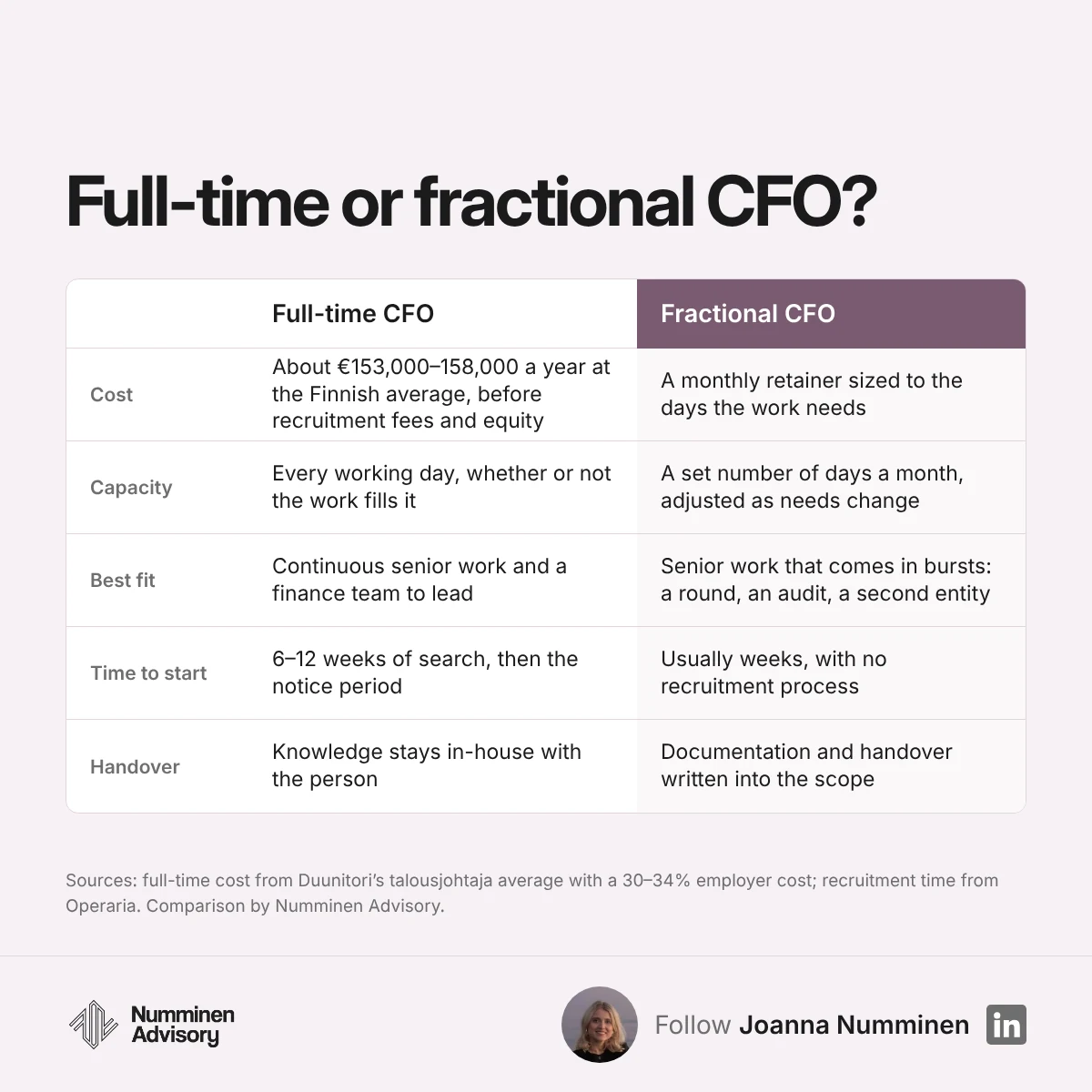
    Fractional CFO vs full-time CFO compared on cost, capacity, best fit, time to start and handover
    Sources: Duunitori, Operaria. Comparison by Numminen Advisory.

    Bottom line

    A CFO hire should solve a named problem on a known timeline. Fix the close before you hire above it, tie the hire to a specific trigger, and write down what the role owns in year one before you meet anyone. Then choose the shape of the role deliberately: full-time when senior finance work fills every week, fractional when it is senior but intermittent, and interim when there is a defined event with an end date. At roughly €153,000–158,000 a year for a full-time CFO in Finland, that choice is the most expensive one on this list to get wrong. Finally, be honest about which part of the discomfort a hire can remove, because the hardest decisions stay with the CEO whoever you hire.

  • Numminen rune numeral 5 (raido)

    What a CEO can’t delegate to finance in startups and growth companies

    Four decisions in a growth company stay with the CEO however good the finance function is: how much risk to carry, when to raise, what to promise the board, and when to stop funding something. Finance should put a price on each option and bring the choice forward in time. The choice itself stays with you.

    There is a pattern I have seen enough times to trust. A company hires good finance people, the reporting improves, the board pack gets tighter, and the CEO gets quieter.

    Not disengaged, just quieter. The questions they used to ask in a slightly anxious way, because nobody had the answer, stop being asked, because the answer now arrives on the twelfth of every month in a document. The anxiety was doing something useful, and its absence went unnoticed.

    The failure mode is rarely that someone else makes these four decisions badly. More often nobody makes them at all, and the default wins.

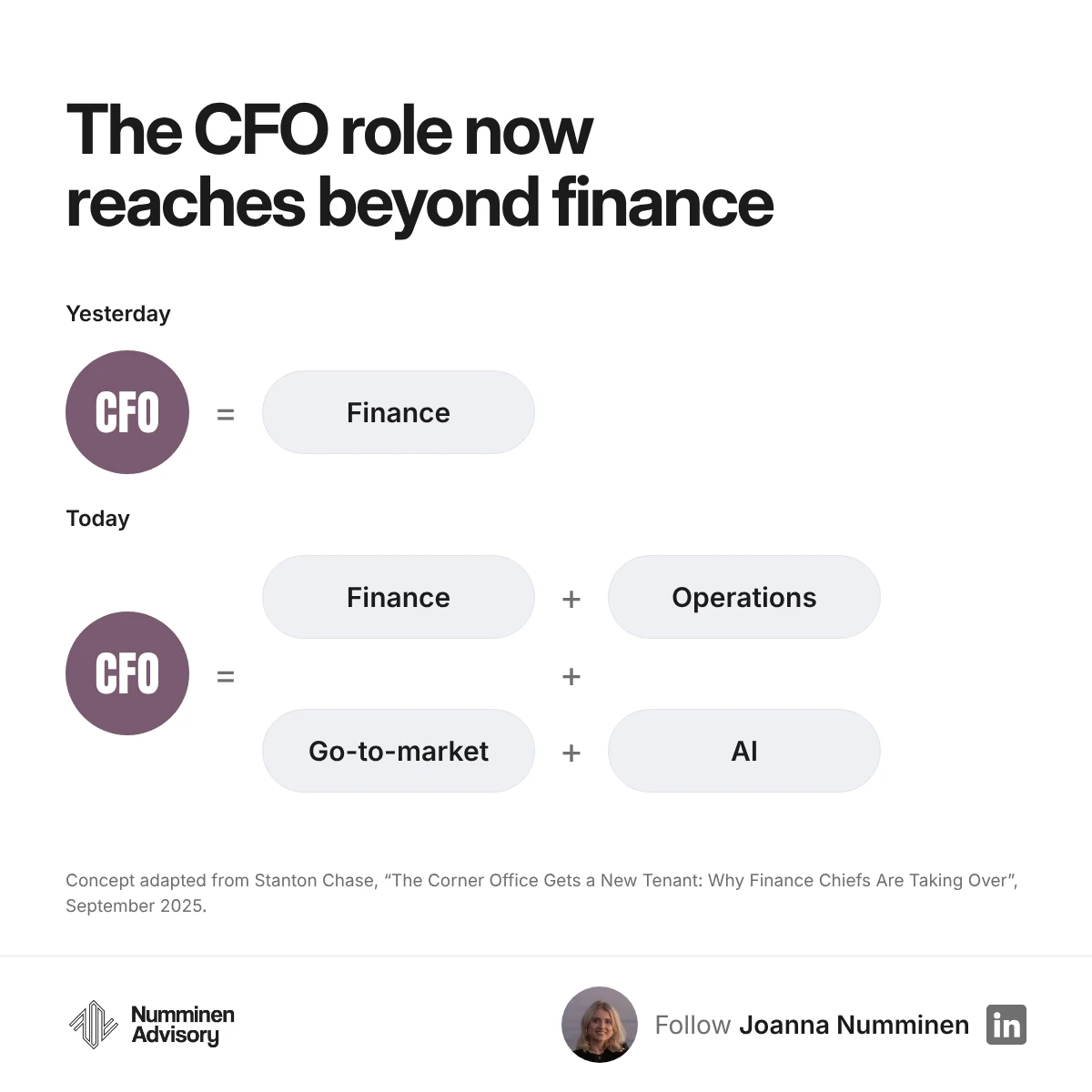
    CFO role and responsibilities: yesterday finance only, today finance, operations, go-to-market and AI
    Concept adapted from Stanton Chase, “The Corner Office Gets a New Tenant: Why Finance Chiefs Are Taking Over”, September 2025.

    1. How much risk to carry

    Do you run this company at eighteen months of runway or at nine? No calculation produces the answer. It depends on your appetite for risk, on how much you believe your own plan, and on what you are willing to have happen if you are wrong. Two competent CEOs in identical companies will answer it differently, and both can be right.

    What finance owes you is the price of each answer. Eighteen months of runway costs you growth you could have bought. Nine months costs you the ability to walk away from a bad term sheet. Those costs can be quantified, and weighing them is your job.

    2. When to raise

    Timing a round is a judgement about your own narrative, weighed against the market’s appetite and against whether the next two quarters will make the story better or worse.

    What finance owes you here is one specific date, the point of no return. After that date, raising becomes something that happens to you, because the runway is short enough for every investor to see it and price it. In my experience it falls six to nine months before the cash runs out, and it is startling how often it arrives without anyone naming it.

    A finance function that reports the cash-out date and leaves out the leverage-out date has given you the less useful of the two numbers.

    3. What to promise the board

    A forecast presented to a board stops being a forecast. It becomes the number you are measured against, and everything after it is either delivery or explanation.

    Finance can build the model and give you a base case with the alternatives around it, such as the two big deals landing or hiring slipping by a quarter. Which of those becomes the commitment is yours to decide. The trap is quiet, because the base case arrives with the authority of having come out of a spreadsheet and gets adopted by default.

    Nobody who built that base case knew what you know about the pipeline. Choose deliberately, and say out loud which version you picked and why.

    4. When to stop funding something

    A product line, a market, a team, a bet. Finance can show you that it consumes €40k a month and has done for fourteen months. What finance cannot tell you is whether the strategic option it represents is still worth buying, because that is a view about the future and it belongs to you.

    A good finance function puts that cost in front of you every month, so the decision keeps getting made. Most things that should have been killed were simply never brought back up.

    Why good reporting can still leave a company drifting

    The failure here is finance that answers in reports. A variance pack describes what happened. If every month produces a document and no month produces a decision, the function is working correctly and the company is still drifting, and it takes a surprisingly long time for anyone to notice because the artefacts all look right.

    There is also a version people rarely say out loud. A CEO who does not fully follow how a number was built will sometimes stop asking, because by month four it feels late to admit it. If this describes you, it is common enough to be unremarkable, and any competent finance person would rather explain it twice than have you nodding at a number you do not trust.

    Running the monthly finance meeting so it produces decisions

    Separate the review from the decision. Send the numbers in advance and treat the pack as prework. A meeting spent walking through the pack has already been used up.

    Write the agenda as questions. “Do we extend the runway or accelerate hiring” works as an agenda item, while “Cash flow” is only a section heading.

    Ask three standing questions every month. Which assumptions changed since last month, which decision is coming that we have not made yet, and where is the earliest place we could be wrong.

    Write down the decision and the reason. Two sentences are enough. In nine months, when it looks obviously wrong, you will want to know what you knew at the time, and that record is what separates a company that learns from its own history from one that relitigates it.

    The part that does not go away

    A good finance function makes these four decisions better informed, and that is occasionally harder, because clarity about a trade-off removes the comfort of not having seen it.

    The decisions stay yours. What you can reasonably ask of finance, and of a fractional CFO if you bring one in, is that they arrive as choices with prices attached, in time to be made.

    Bottom line

    Four decisions stay with the CEO however strong the finance function becomes: how much risk to carry, when to raise, what to promise the board, and when to stop funding something. Finance should put a price on each option and bring the decision forward in time, including naming the point of no return for a raise, which in my experience falls six to nine months before the cash runs out. Run the monthly finance meeting around decisions rather than reports, write down what was decided and why, and treat a quiet month as a prompt to check which decision is being made by default.

  • Numminen rune numeral 7 (gebo)

    How to build a finance function as you turn from a startup to a scaleup

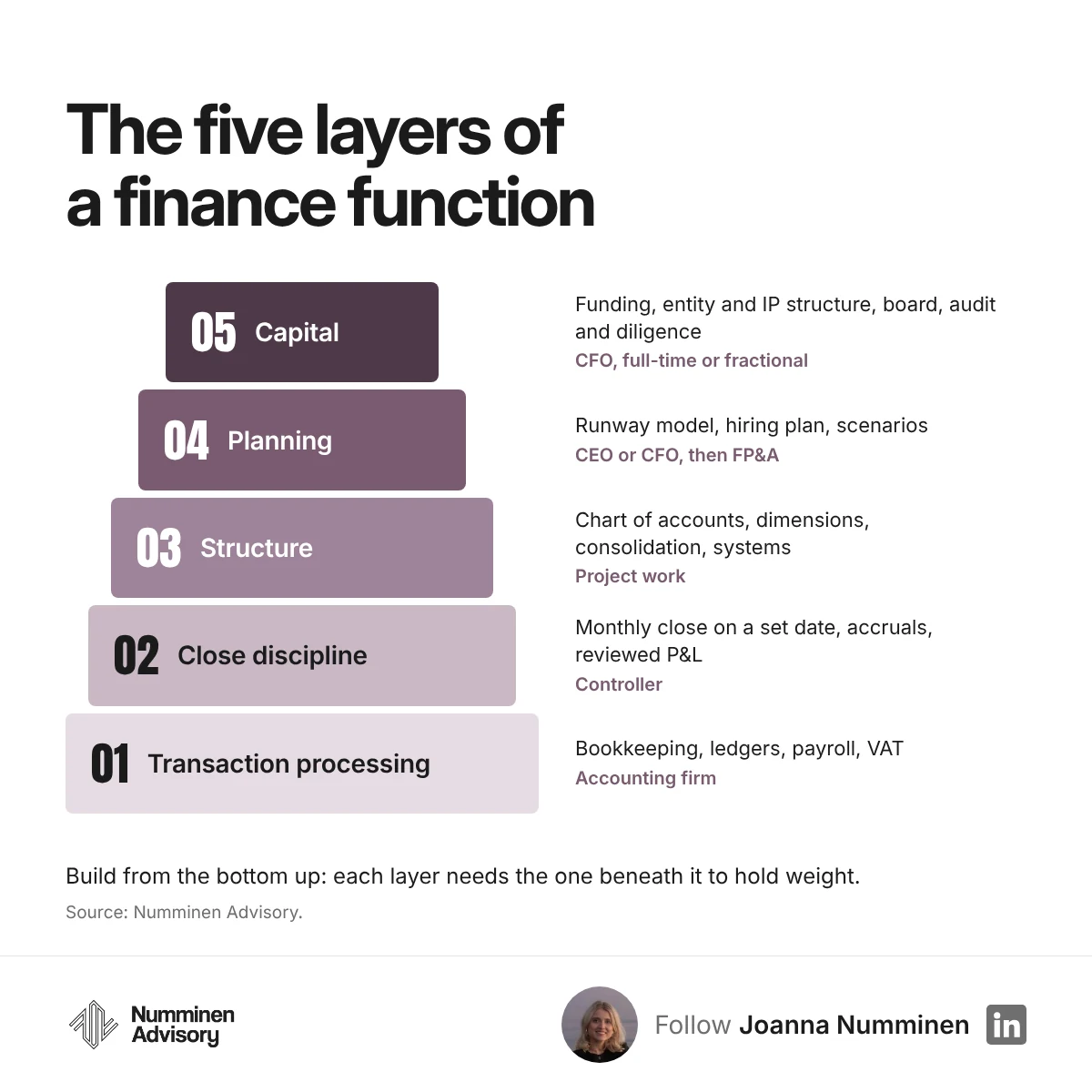
    A growth company’s finance function works best when it is built in five layers, in this order: transaction processing, close discipline, structure, planning, and capital. The expensive mistakes almost always come from building a higher layer before the one beneath it can hold weight.

    I have spent more than 15 years building and running finance functions at very different stages of growth: in international finance operations at high-growth scaleups such as Groupon and Indeed.com, and as a finance leader at fast-growing startups including Silo AI and ONEiO. Each of them needed a different finance function, and I have seen at first hand what it costs when a layer is built too early and when it is built too late. The order below is the one I follow when I build a finance function today.

    Finance functions get built in the wrong order more often than they get underbuilt. The money is usually there, and it goes into the wrong layer first.

    Finance team structure as five layers: transaction processing, close discipline, structure, planning and capital
    Source: Numminen Advisory.

    Layer 1. Transaction processing

    What it is. Bookkeeping, the purchase and sales ledgers, payroll, VAT and statutory filings.

    Who does it. An accounting firm, for longer than most founders expect.

    What it costs. Mostly a function of transaction volume and the number of entities, so ask for pricing per entity.

    When to change it. When your accounting firm starts slowing down the information you need. That usually shows up as management figures arriving on the twentieth of the following month.

    The mistake at this layer is hiring an in-house bookkeeper too early because the accounting firm is annoying. The annoyance is usually a specification problem, and a better brief to the firm fixes most of it.

    Layer 2. Close discipline

    What it is. A monthly close that lands on a predictable date and produces a management P&L someone has reviewed before it goes out, with accruals and cut-off handled properly.

    Who does it. A controller, or a finance manager (talouspäällikkö) if you also want someone owning process.

    What it costs. Duunitori’s salary data, based on Statistics Finland figures for 2024, puts the average controller salary at €4,806 a month and the average talouspäällikkö at €5,695 a month, before employer costs.1, 2

    Trigger. You have started making decisions every month, or an investor has started asking for figures on a schedule.

    This is the layer everything else stands on. A forecast built on a close you do not trust is theatre, and a board pack built on it is worse, because it is persuasive theatre.

    Layer 3. Structure that survives growth

    What it is. A chart of accounts designed for the company you will be in two years, cost centre and project dimensions, a consolidation method that goes beyond a manually maintained spreadsheet, and a system stack that can carry a second entity.

    Who does it. This is project work with a defined end.

    Trigger. The second entity, the first grant with allocation requirements, or the first time someone asks for revenue split by something your ledger cannot produce.

    The mistake here is buying the system before designing the structure. An ERP implemented on top of an undesigned chart of accounts is an expensive way to make the same mess faster, and it is very hard to unwind.

    Layer 4. Planning

    What it is. A model somebody owns, covering runway, the hiring plan, scenarios and the link between the operating plan and the cash position.

    Who does it. At first the CEO or the CFO. An FP&A analyst comes in once the assumptions are stable enough for someone to maintain the model.

    Trigger. The first time a board conversation turns on a projection.

    Analysts are good at maintaining assumptions and should not have to source them, which is why hiring an analyst to own a model that nobody has defined tends to go badly.

    Layer 5. Capital and structure

    What it is. Funding strategy across equity, debt and non-dilutive sources, entity and IP structure, investor and board relations, audit and diligence readiness, and exit preparation.

    Who does it. A CFO. Whether that is a full-time hire or a fractional arrangement depends on how much of this work there is.

    What it costs. The average talousjohtaja salary in Finland is €9,823 a month (Duunitori, Statistics Finland data for 2024).3 Statutory employer contributions add about 20 percent of salary in 2026, and once holiday bonus, paid sick leave and occupational healthcare are counted, the real employer cost is closer to 30 to 34 percent.4 A full-time CFO at that average therefore costs roughly €12,800–13,200 a month. I show the full calculation in my note on Finland’s interim market survey. Executive search firm Operaria puts a typical leadership recruitment in technical industries at about 6–12 weeks, and the candidate’s notice period comes on top of that.5

    Trigger. A round, an audit, a second country, or a grant portfolio large enough to carry real compliance exposure.

    Four inversions worth naming

    Senior finance before a reliable close. This is the most expensive inversion. You pay CFO money for six months of remedial controller work, and the person leaves, because that is not the job they took.

    Systems before structure. The tell is a system selection process running before anyone has written down what the reporting needs to produce.

    Headcount before scope. Two junior finance hires often solve less than one correctly specified role plus a better brief for the accounting firm.

    Consolidation handed to your auditor’s firm. It is convenient and cheap, and it creates an independence problem the moment the group matters enough to be audited properly, because the auditor ends up reviewing work its own firm produced. Build consolidation in-house, or buy it from someone independent of your auditor. The group consolidation page describes how I approach it.

    The eighteen-month question

    Almost none of this needs to happen at once, and the sequence differs by company. A single-entity SaaS business heading into a Series A builds a different function from a three-entity hardware group with a Business Finland loan and a US subsidiary.

    The question worth answering properly is what finance needs to look like in eighteen months and in what order to get there, including which parts to hire and which to outsource. It takes a few days to answer well and costs considerably less than answering it wrong.

    Bottom line

    You do not need the whole finance function at once. You need the right layer at the right time, built on the one beneath it.

    Build in order. Transaction processing, close discipline, structure, planning and capital, each one only once the layer below it can hold weight.

    Get the close right first. A reliable monthly close is the foundation for every forecast, board pack and funding conversation that follows. Hire a controller before senior finance.

    Design before you buy. Settle the chart of accounts, dimensions and consolidation method before choosing a system.

    Bring in a CFO for capital decisions. A round, an audit, a second country or a significant grant portfolio is the point where capital and structure need an owner. How much of that work there is decides whether the role should be full-time or fractional.

    Plan eighteen months ahead. Decide what finance needs to look like by then, in what order to build it, and which parts to hire and which to outsource.

    References

    1. Duunitori. Controller palkka. Statistics Finland wage data for 2024.
    2. Duunitori. Talouspäällikkö palkka. Statistics Finland wage data for 2024.
    3. Duunitori. Talousjohtaja palkka. Statistics Finland wage data for 2024.
    4. Finnish Centre for Pensions (ETK). Statutory social insurance contributions in Finland in 2026. January 2026.
    5. Operaria. Kuinka pitkä prosessi johdon rekrytointi yleensä on?. 24 April 2025.
  • Numminen rune numeral 8 (wunjo)

    State of the Interim CFO market in Finland in 2026

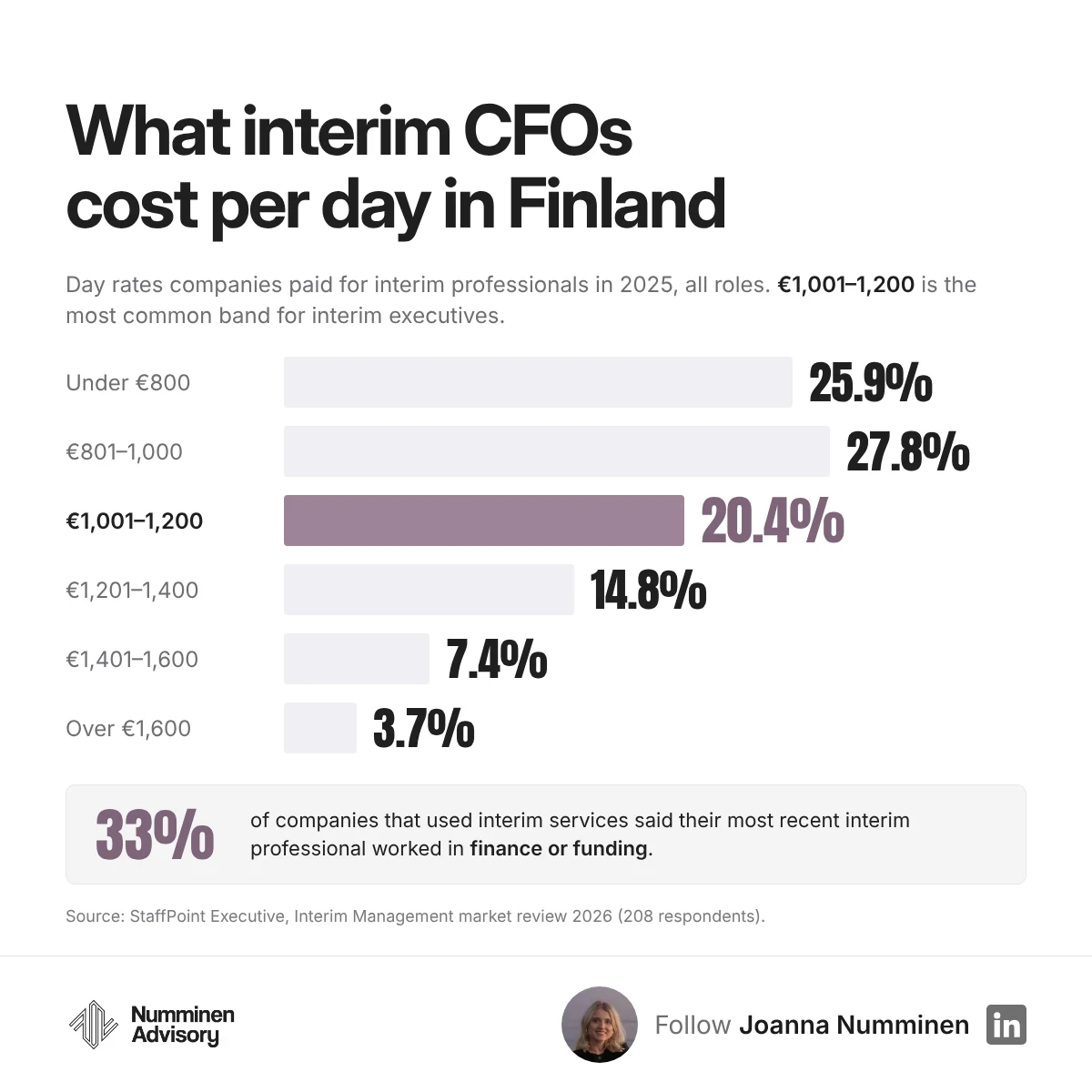
    StaffPoint Executive’s Interim Management market review 2026 is one of the few detailed public pictures of what Finnish companies pay for temporary senior help.1 Two findings matter most to anyone buying finance leadership. Finance is the function where companies most often bring in outside help: 33% of companies that had used interim professionals said their most recent one worked in a finance or funding role.2 And the most common day rate for interim executives is €1,001–1,200, with about a quarter of buyers paying more than €1,200.1

    Those numbers are useful. They are also easy to misread, because a day rate tells you what a day costs, and very few growth companies need senior finance every day.

    What the survey measured

    The review is StaffPoint Executive’s fifth annual study of the Finnish interim market. The survey ran in late 2025 and had 208 respondents in three groups: interim professionals, companies that had used interim services, and companies that had not.1 Half of the company respondents were CEOs or leadership team members at organisations that had never used an interim professional, which gives the review a view from outside the market as well as inside it.

    The full report can be downloaded from StaffPoint’s page, behind a short form.1 A press release of 11 March 2026 summarises the headline figures.2

    Finance is where Finnish companies buy outside leadership most

    In the report, finance and funding is the largest single category for the role of the most recent interim hire, at 33.3%. HR follows at 11.1% and digital business leadership at 9.3%.1 CFO roles also appeared among the “other” answers.

    According to the report, interim work in finance and HR has long been established in Finland, and funding, compliance and legal work appeared as notable new areas in 2025.1 That matches our experience. The finance work that reaches outside help tends to cluster around a round, an audit, a second entity or a group structure that outgrew its bookkeeping, where a company needs judgement it does not yet employ.

    What the day rates look like

    Among companies that had used interim services, the day rates they paid in 2025 were spread like this:

    • Under €800 a day: 25.9% of companies
    • €801–1,000: 27.8%
    • €1,001–1,200: 20.4%
    • €1,201–1,400: 14.8%
    • €1,401–1,600: 7.4%
    • Over €1,600: 3.7%

    Source: StaffPoint Interim Management market review 2026.1

    Interim CFO day rates in Finland 2026: €1,001–1,200 a day is the most common band for interim executives (StaffPoint)

    StaffPoint’s press release puts the most common band for interim executives at €1,001–1,200 a day and for interim specialists at €801–1,000.2 Two cautions apply before anyone treats the table as a price list. It mixes every function and seniority level, and StaffPoint itself describes pricing as falling into rough tiers by seniority, up to demanding C-level mandates. It also comes from the respondents who had bought interim services, a much smaller group than the 208 in total.

    Fees, the report says, have not risen. In places they have moved down to levels it calls commercially unsustainable.1 Price is still not the main criterion companies use when choosing an interim professional.

    Why the day rate is the wrong starting point

    A day rate is the right unit when you are replacing a person for a fixed period. If your CFO has left and someone needs to sit in the seat full time until a successor arrives, you are buying days, and the table above is roughly what they cost.

    Most growth companies below a certain size are in a different situation. The work that needs a CFO is senior but intermittent: a board pack each month, a funding model before a raise, a consolidation question when the second entity appears, a view on runway when the plan changes. Together it comes to a few days a month, and the useful question is how many days of senior judgement the company can actually use.

    The arithmetic shows why. An interim executive at €1,100 a day, working a typical month of around 20 days, costs about €22,000 a month. The figure is our illustration, using the survey’s middle band. The same senior person for four days a month costs a fraction of that, even at a higher day rate. The report points the same way from the billing side, where day billing is still the most common model and monthly billing has become the established second choice.

    A fractional CFO works on this logic, as a monthly arrangement sized to the work with no end date. Our own retainers are published on the pricing page in days per month, so the comparison can be made directly.

    The full-time benchmark, calculated

    The other comparison founders make is with hiring, and we start that calculation from public salary data. Duunitori’s salary data, based on Statistics Finland’s wage structure statistics, puts the average monthly salary for a talousjohtaja (CFO or finance director) at €9,823, from 1,069 salaries in 2024.3

    An employer also pays statutory contributions and insurance on top of salary. Statutory contributions alone come to about 20% of salary in 2026, based on the rates published by the Finnish Centre for Pensions (ETK).4 Accident and group life insurance come on top, so we use 20–25% of salary as our working estimate for employer costs, the same figure used across our site. Holiday bonus, paid sick leave and occupational healthcare would add more. That gives:

    • €9,823 × 1.20 = €11,788 a month
    • €9,823 × 1.25 = €12,279 a month

    So a full-time CFO at the national average costs roughly €11,800–12,300 a month, or about €141,000–147,000 a year, before recruitment fees, equity, benefits and the months it takes to hire. The average covers every industry and company size, and we would expect a CFO for an international, investor-backed group to sit above it.

    None of this makes fractional cheaper by definition. It makes the two options comparable, which is the point. If the work needs a full-time person, hire one. If it needs four days a month, a full-time hire buys capacity the company cannot use.

    What the survey says about ending well

    The weakest area in the report is the end of the assignment. Companies rate collaboration with interim professionals highly, but StaffPoint finds room to improve in systematic follow-up of goals and progress, and especially in the transfer of knowledge when an assignment ends, which it says needs more planning and clarity.

    For finance this matters more than for most functions, because the knowledge that walks out of the door is the reasoning behind the numbers, such as why a revenue policy was chosen and what the auditor was told about it last year. Any external finance arrangement, interim or fractional, should put written documentation and handover into the scope from the first day.

    How we would use these numbers

    1. Decide the number of days before you compare prices. A day rate only means something once you know how many days the work needs.
    2. Check what the price includes. Ask whether it is quoted with or without VAT, and whether a broker’s fee sits on top.
    3. Compare against the loaded cost of a hire. Use the calculation above, adjusted for the seniority you need.
    4. Put handover in the scope. Documentation of how the finance function works should be a deliverable, whoever does the work.

    The review describes a market that is busy in finance and flat on price. For a founder, the practical lesson is simpler than any of the tables: work out how much senior finance judgement the company needs each month, and buy that amount.

    Bottom line

    Finance is the function where Finnish companies most often bring in outside leadership, and the most common interim executive rate is €1,001–1,200 a day. A day rate only means something once you know how many days the work needs. Full-time interim cover at that rate runs to about €22,000 a month, and a full-time CFO hire at the national average costs roughly €141,000–147,000 a year once employer costs are included. Most growth companies need senior finance judgement for a few days a month rather than every day. Size the work first, compare every option against the loaded cost of a hire, put handover in the scope from day one, and buy only the senior finance the company can actually use.

    References

    1. StaffPoint Executive. Interim Management markkinakatsaus 2026. 2026.
    2. StaffPoint via STT Info. Selvitys: Vuokrajohtajien ja -asiantuntijoiden määrä kasvanut yrityksissä. Press release, 11 March 2026.
    3. Duunitori. Talousjohtaja palkka. Statistics Finland wage data for 2024.
    4. Finnish Centre for Pensions (ETK). Statutory social insurance contributions in Finland in 2026. January 2026.
  • Numminen rune numeral 4 (ansuz)

    How to prepare your startup for multi-entity finance operations

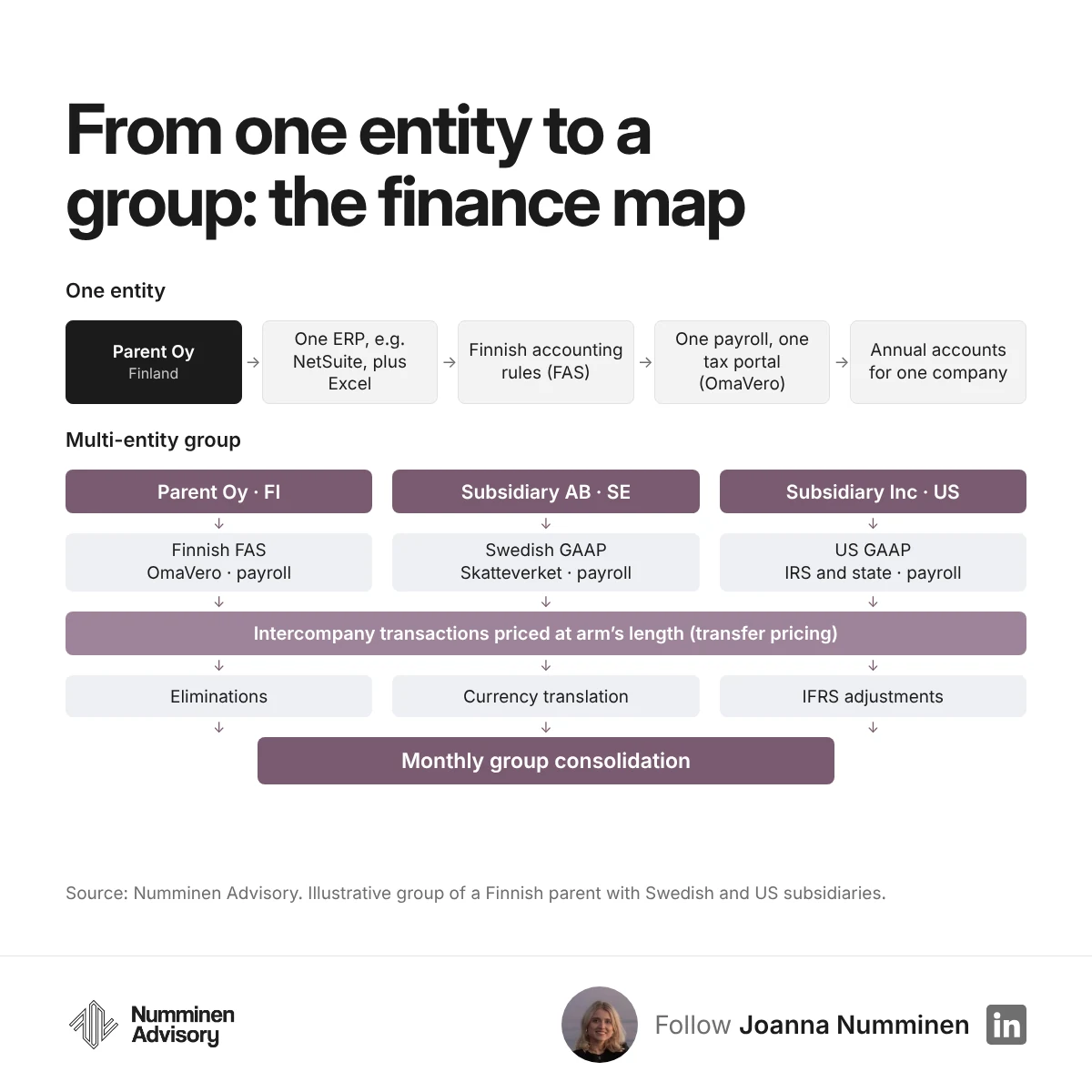
    Setting up a second legal entity, usually a foreign subsidiary, is the sharpest dividing line in a growth company’s finance function. From that point the company is a group, with intercompany transactions to price at market terms, consolidation to run, local payroll and tax to manage, and often two or three accounting frameworks running at once. The work starts before the entity exists and never stops.

    Most Finnish technology companies incorporate abroad for a commercial reason. A customer requires a local contracting party, or a salesperson needs an employment contract. Sometimes an investor wants a US holding structure. The decision gets made in a board meeting, handed to a law firm and closed a few weeks later when the certificate arrives. Finance usually hears about it afterwards.

    What changes when you have a group

    You now have a group to consolidate. Two sets of books have to be added together and then partly subtracted from each other. Intercompany balances must agree in both ledgers to the cent, even though each side was posted by different people in different systems on different days. Eliminations have to be repeatable every month.

    Finnish law lets a parent skip consolidated financial statements when the group is small, meaning it exceeds at most one of three limits: a balance sheet of €7.5 million, turnover of €15 million, or an average of 50 employees.1 The exemption removes a filing obligation and leaves everything else in place.2 Your board and investors still need to see the group, and a future acquirer will want three years of group history produced consistently.

    Transactions between your companies need a price. The moment your Finnish company does something for your foreign company, or the reverse, that transaction has to be priced as if the two were unrelated parties. Two separate obligations get conflated here. The obligation to price at arm’s length applies at any size. The obligation to keep formal transfer pricing documentation depends on size, and in Finland a company that meets the EU definition of a small or medium-sized enterprise is exempt from it. That means fewer than 250 employees and either turnover of at most €50 million or a balance sheet of at most €43 million.3 The Tax Administration’s guidance is explicit that the relief stops at documentation, because the arm’s length principle “is applied in the same way to all transfer pricing cases.”

    Founders hear “we’re too small for transfer pricing” from someone who meant the documentation, and conclude the pricing does not apply either. A tax auditor reviewing an intercompany recharge four years later will want to know whether the price was defensible. The practical fix is a two-page document, written before the first invoice, setting out what each entity does for the other and on what basis. The transfer pricing page covers how that document turns into monthly bookkeeping.

    Permanent establishment risk often arrives before the entity does. It frequently starts with a salesperson who has been closing deals from another country for eight months, and the incorporation is the response to a problem that has already been running. Under the OECD model tax treaty, a person who habitually concludes contracts for a company in another country, or habitually plays the principal role in concluding them, can create a taxable presence there, although the exact test depends on the treaty between the two countries.4 If you are incorporating because someone is already there, start by looking at what happened in the months before the new entity existed.

    Payroll becomes local. You need local employer registration and social security arrangements, and a payroll calendar that does not line up with your Finnish one. Employees who work in another EU country need an A1 certificate showing which country’s social security covers them, and in Finland the Finnish Centre for Pensions issues it.5

    You may now have two functional currencies. Under IFRS, a foreign subsidiary’s assets and liabilities are translated at the closing rate, its income and expenses at the rates on the transaction dates, and the resulting differences go to other comprehensive income.6 A subsidiary operating in dollars and consolidated into a euro parent will therefore move group equity for reasons unrelated to performance. The first time this appears in a board pack, someone will ask why equity changed when nothing happened, and someone should be ready with the answer.

    Multi-entity accounting map: one entity versus a group with intercompany transactions, local GAAP and monthly consolidation
    Source: Numminen Advisory. Illustrative group.

    Two frameworks, sometimes three

    Your Finnish entity reports under Finnish accounting rules because Finnish law and the tax authority require it, and your subsidiary reports under its own country’s framework for the same reason. If your investors or an eventual acquirer are international, you will also be asked for IFRS, or for US GAAP when the counterparty is American. That can mean three frameworks running concurrently off one set of transactions, and the differences that bite a technology company are specific and predictable.

    Development costs. Under IFRS, research is expensed and development spending that meets specified criteria is recognised as an intangible asset.7 Under US GAAP, research and development costs are generally expensed as incurred, with separate rules for software.8 Finnish rules allow development costs to be capitalised, and the amount not yet written off cannot then be distributed as profit.9 The same engineering spend can legitimately be an asset in one set of accounts and a cost in another, and EBITDA moves with it. If nobody has decided which number the company manages against, it ends up managing against whichever one was produced most recently.

    Government grants. This matters if you carry external funding. Under IFRS, grants fall under IAS 20, which also treats the benefit of a below-market-rate government loan as a grant.12 US GAAP had no dedicated standard for business entities until the FASB issued one on government grants in December 2025, and that standard leaves below-market-rate loans outside its scope.10 Grants are often large enough to change how a period reads.11

    Leases. IFRS 16 requires a lessee to recognise a right-of-use asset and a lease liability for leases longer than twelve months unless the asset is of low value.13 Under Finnish accounting practice, lease payments are generally expensed.14 If your office lease is significant, your group balance sheet under IFRS looks different in ways that can affect covenant calculations and any multiple applied to it.

    Revenue recognition, at least, is largely aligned. IFRS 15 and the US standard, ASC 606, remain substantially converged, although some differences exist.15

    You do not need three sets of books. You need one set of underlying data, structured so that three views can be produced without three months of manual work, and that structure is a design decision you make once.

    Why “our accounting firm will handle it” runs out

    It is the natural answer, and it works for a while. Two problems arrive later.

    The first is timing. An accounting or audit firm building your consolidation usually treats it as a year-end exercise, so group numbers appear once a year, months after the year ends. That is adequate for filing. Running a company or populating a data room needs the group position every month.

    The second is independence. If your audit firm builds the consolidation, it later audits its own work. That is manageable while the group is small and becomes a real problem exactly when the group starts to matter, so build the capability internally, or buy it from someone independent of your auditor, and do it deliberately.

    The cost of doing it late

    Diligence typically looks back two to three years. If your group only consolidated properly from year three, you will rebuild years one and two under time pressure, from records never designed to be assembled that way, while answering hundreds of other questions.

    The design work itself, meaning a chart of accounts with an entity dimension, an intercompany account structure, elimination logic and a group close calendar, takes perhaps a week when there is no history. After two years of transactions it becomes a project, running at the same time as something more important. The group consolidation page sets out what that project covers.

    Eight things to settle before the certificate arrives

    1. Why this entity exists, in one sentence. Sales, employment, IP, a customer requirement or an investor structure lead to different answers for everything below.
    2. What it will own. Which assets it will hold, such as IP or customer contracts, and explicitly what stays with the parent.
    3. How it is funded. Equity, an intercompany loan or recharges each carry different tax and currency consequences, loans can raise thin capitalisation questions, and changing the choice later is harder than making it now.
    4. The intercompany model. What it charges and is charged, on what basis, in which currency and on what cycle, in two pages written before the first invoice.
    5. Functional currency, and which entity carries the currency exposure.
    6. Reporting calendar. A financial year end aligned with the parent’s unless there is a reason otherwise, local statutory deadlines mapped, and one group close date everyone works to.
    7. Chart of accounts. The same structure in both entities with an entity dimension, plus a deliberate decision on whether consolidation happens inside the accounting system or outside it. That decision is the most expensive one to reverse.
    8. Who is accountable locally. Who holds director duties and signing authority there, and who actually files what.

    None of this needs to delay the incorporation, because it can run in parallel. The mistake is doing it in sequence, with the legal work first and finance told afterwards, so the structure gets inherited by default.

    The certificate takes days. The structure lasts until someone buys you.

    Bottom line

    A second legal entity turns a company into a group, and the finance function changes with it: a consolidation to run every month, an arm’s length price on every intercompany transaction, local payroll and tax, possible permanent establishment exposure, currency effects in group equity, and up to three accounting frameworks running off one set of transactions. All of it is straightforward to design before the entity exists and expensive to rebuild after two years of history. Settle the structure before the certificate arrives, run that work in parallel with the legal work, and keep the consolidation independent of your auditor.

    General observations, not tax or legal advice for any particular situation. Thresholds, exemptions and framework requirements change, and the right answer depends on the jurisdictions involved.

    References

    1. Kirjanpitolautakunta. Konsernikokorajojen arvioimisesta. Statement 2101, 25 February 2025.
    2. Kirjanpitolautakunta. Konsernitilinpäätöksen laatimisvelvollisuudesta. Statement 2110, 8 April 2025.
    3. Verohallinto (Finnish Tax Administration). Transfer pricing documentation. 28 April 2022.
    4. KPMG in India. OECD BEPS Action 7: Preventing the Artificial Avoidance of Permanent Establishment Status. 3 November 2015.
    5. Finnish Centre for Pensions (ETK). What is an A1 certificate.
    6. IFRS Community. Effects of Changes in Foreign Exchange Rates (IAS 21). Updated 14 May 2025.
    7. IFRS Foundation. IAS 38 Intangible Assets.
    8. KPMG. R&D costs: IFRS Accounting Standards vs. US GAAP. 13 March 2025.
    9. Kirjanpitolautakunta. Taseeseen aktivoitujen kehittämismenojen merkityksestä osakeyhtiölain 12 luvussa säädetyn pääomalainan pääoman palautukselle ja koron maksulle. Statement 2143, 9 June 2026.
    10. IFRS Community. Government Grants, Government Assistance (IAS 20). Updated 17 May 2024.
    11. Crowe. FASB Issues Final ASU on Government Grants for Businesses. 12 December 2025.
    12. IFRS Foundation. IAS 20 Accounting for Government Grants and Disclosure of Government Assistance.
    13. IFRS Foundation. IFRS 16 Leases.
    14. Azets. Vuokrasopimusten aktivointi IFRS 16 mukaan. 19 May 2024.
    15. KPMG. Revenue accounting: IFRS Accounting Standards vs US GAAP. Updated 16 September 2026.
  • Numminen rune numeral 3 (thurisaz)

    AI in finance: what Nordic finance leaders need to know in 2026

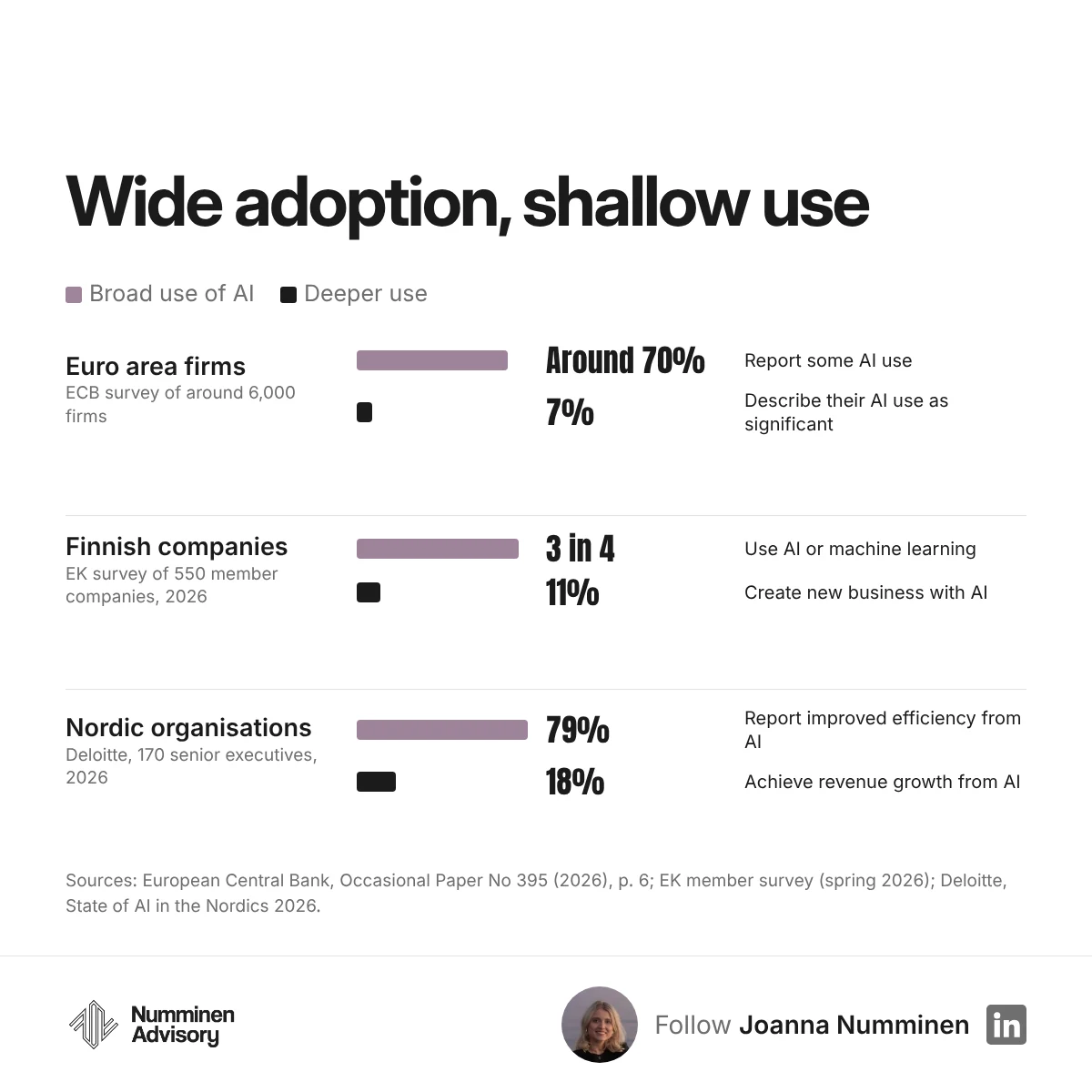
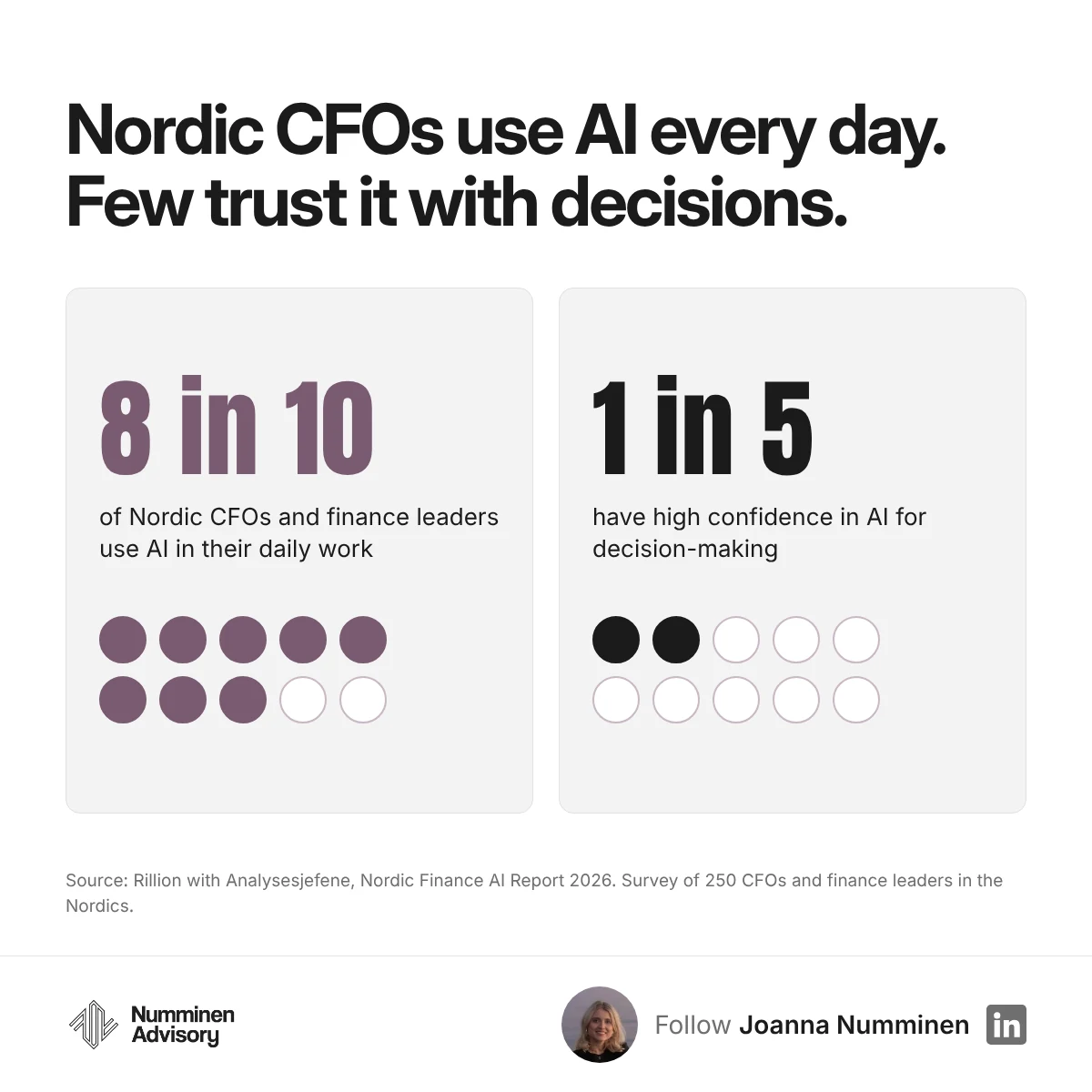
    Nordic companies use AI more widely than almost anyone else in Europe. Inside the finance function the picture is more modest: most teams run pilots and assistants, few have AI in core processes, and the distance to large global finance functions lies mainly in depth of use.

    Key takeaways

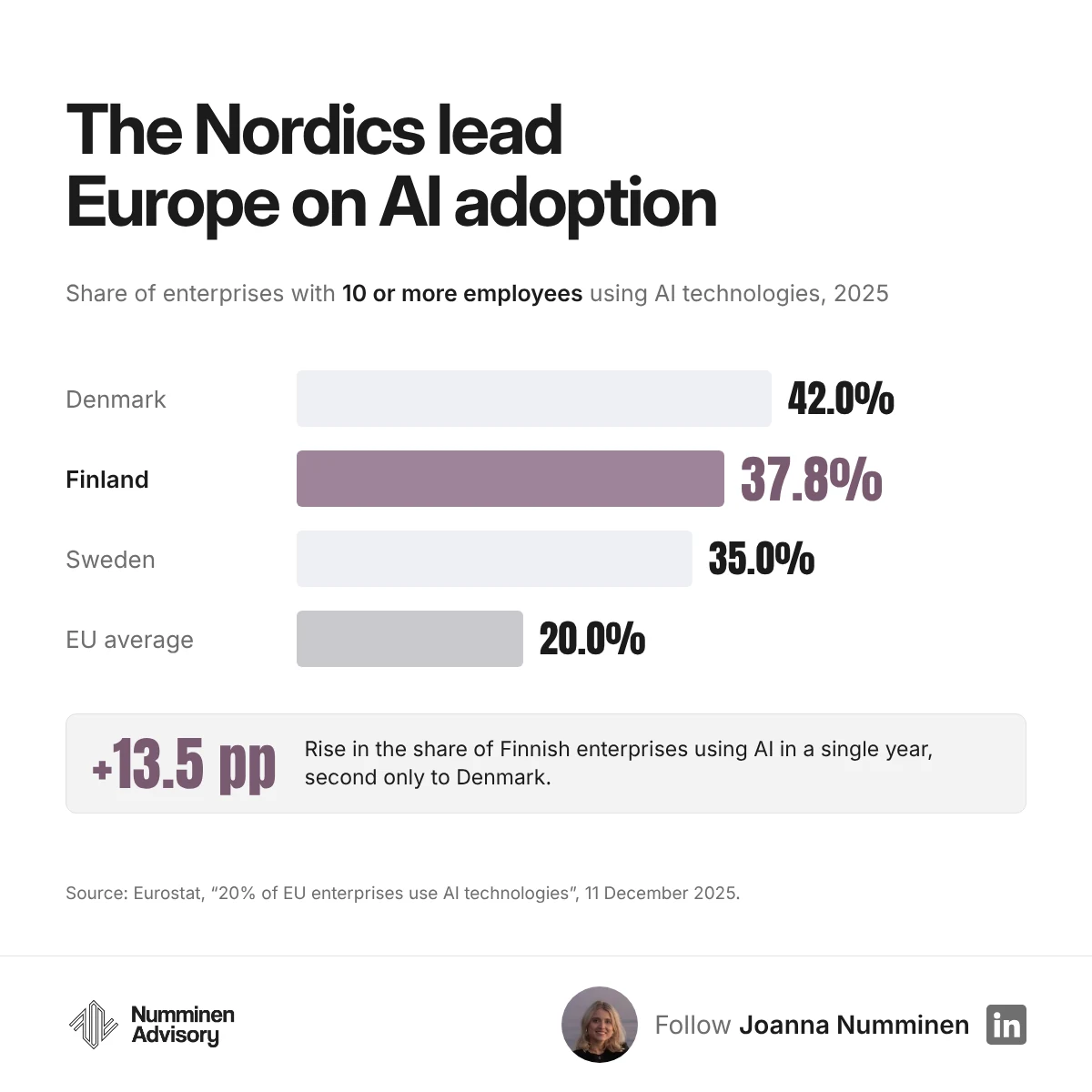
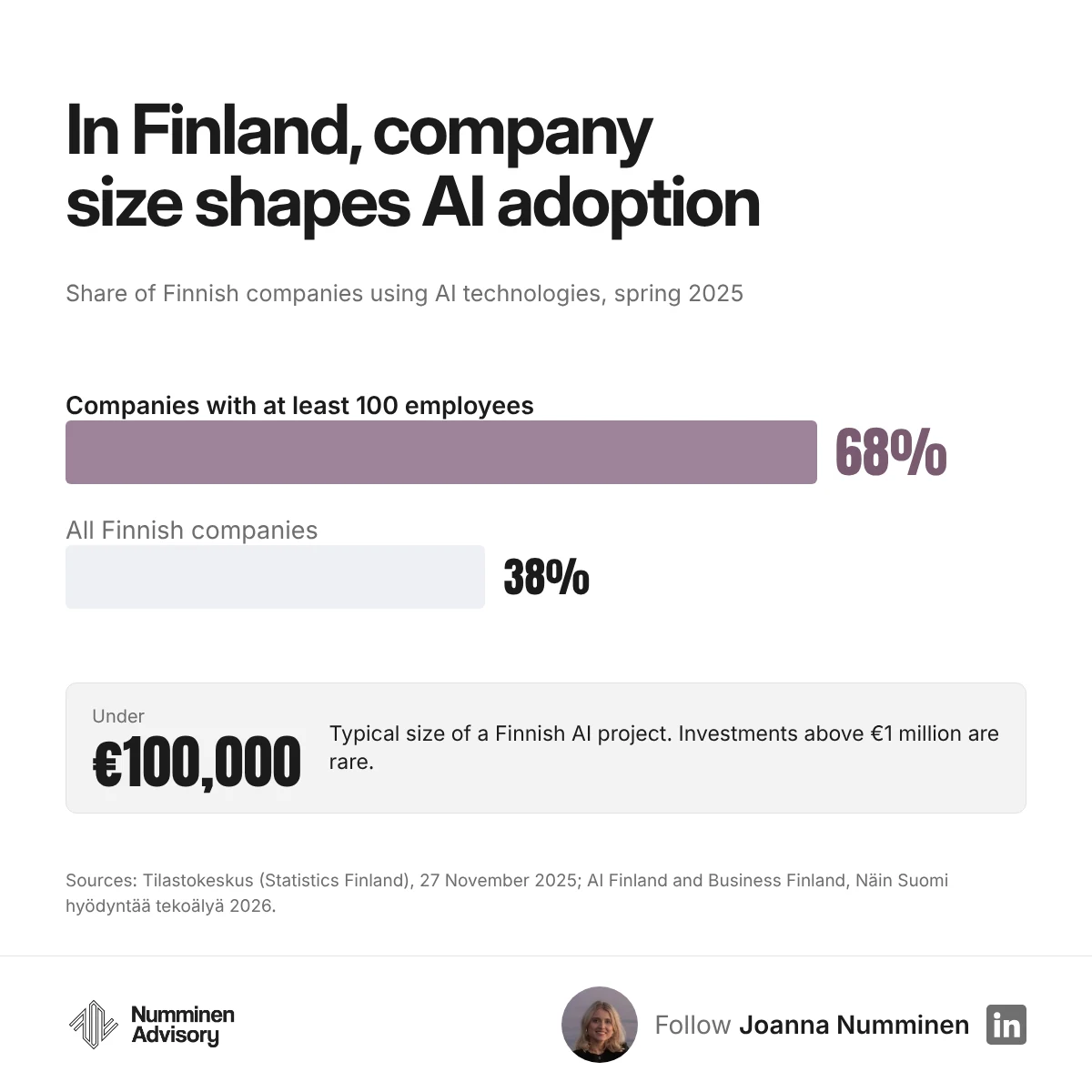
    • Finland, Denmark and Sweden have the highest share of companies using AI in the EU, at 37.8%, 42.0% and 35.0% against an EU average of 20.0%.1
    • Use is wide and shallow. Only 22% of Nordic organisations have moved 40% or more of their AI experiments into production.2
    • 8 in 10 Nordic CFOs use AI in their daily work. One in five has high confidence in it for decision-making.3
    • Globally, the returns show up in speed and decision quality more than in headcount savings.4, 5
    • The main brakes in Nordic finance teams are poor data, low confidence in AI output and a shortage of in-house expertise.3, 6

    How widely do Nordic companies use AI?

    By the broadest measure, the Nordics lead Europe. Eurostat’s 2025 figures show that 20.0% of EU enterprises with 10 or more employees used AI technologies, up from 13.5% a year earlier.1 Denmark (42.0%), Finland (37.8%) and Sweden (35.0%) top the list, and Finland’s share rose by 13.5 percentage points in a single year.1

    AI in finance: Denmark 42.0%, Finland 37.8% and Sweden 35.0% lead EU company AI adoption, against a 20.0% EU average

    Statistics Finland reports the same jump from the national side: 38% of Finnish companies used AI technologies in spring 2025, 14 percentage points more than the year before.7 At that pace, about a third of the Finnish companies using AI took it up within the past year.

    The European Central Bank’s survey of around 6,000 euro area firms asks the question more loosely and gets a higher number. Around 70% of euro area firms report some AI use, and Finland sits with the Netherlands and Austria among the countries where more than 80% of firms report some adoption.8

    Wide adoption, shallow use

    The same ECB survey carries the more telling figure. Of that 70%, only 7% describe their AI use as significant.8

    Finnish data points the same way. In the Confederation of Finnish Industries’ spring 2026 survey of 550 member companies, three in four use AI or machine learning.9 Most of that use goes into what already exists, with 83% of AI users applying it to current processes. New business built on AI is reported by 11% of respondents.9

    AI in finance: about 70% of euro area firms use AI, but only 7% describe their use as significant

    AI Finland and Business Finland describe two groups moving at different speeds. The number of advanced companies has more than quadrupled in two years, and more than half of organisations remain in evaluation and preparation.10 A typical Finnish AI project costs under €100,000, and investments above €1 million are rare.10

    Deloitte’s State of AI in the Nordics 2026, based on 170 senior executives across Denmark, Finland, Norway and Sweden, adds a worrying trend. Strategic preparedness fell from 61% to 43% in a year, and talent preparedness sits at 14%.2 Only 5% report high expertise in agentic AI, and 49% expect agentic transformation to be more than three years away.2

    Inside the finance function: Nordic CFOs and the global picture

    Rillion’s Nordic Finance AI Report 2026 surveyed 250 CFOs and finance leaders. 8 in 10 already use AI in their daily work.3 Nearly half of Danish finance leaders report broad use of AI across the finance function, against 37% in Finland and 34% in Sweden.3

    AI in finance: 8 in 10 Nordic CFOs use AI daily, but only 1 in 5 has high confidence in it for decisions

    Large companies elsewhere report higher numbers. KPMG’s survey of 1,013 senior finance leaders at companies with revenues above US$250 million found that active AI use in the finance function has moved from 30% to 75% in two years.5 Protiviti’s 2026 survey of 902 finance executives puts it at 77% of finance groups.11

    Use is one thing and results are another. Of those AI-using finance groups, only 14% have defined an AI strategy.11 In a Gartner survey of 183 CFOs, 84% of finance organisations have implemented or plan to implement AI, yet only 7% report a high or very high impact.12

    The samples differ, so the comparison is indicative. Still, the Nordic gap to global leaders looks smaller once results enter the picture, because large international finance functions struggle to turn use into measurable value as well.

    Where AI is creating value in finance

    Much of the pitch for AI in finance has been about lower cost. The survey data describes something different. When Bain & Company asked CFOs to name their biggest AI win, speed and cycle-time reduction led at 48%, ahead of headcount or cost savings at 34%.4

    KPMG’s findings point in the same direction. The largest improvements are in judgment work: decision-making quality (70%), decision-making speed (71%) and forecasting accuracy (64%).5 Transactional processes improve as well, by smaller margins.5 Forecasting is also where adoption has gone furthest, with 76% of AI-using finance groups applying it there.11

    Across Nordic organisations as a whole, the gains so far are mostly in efficiency. For every organisation seeing revenue growth from AI, more than four report efficiency gains: 79% against 18%.2

    What holds Nordic finance teams back

    AI in finance: what holds Nordic finance teams back, from manual invoice corrections (72%) to poor data (64%)

    Data quality

    In a survey by Taloushallintoliitto and Floness of Finnish accounting professionals, 64% named incomplete or incorrect data as a major obstacle to using AI.6 Sentiment is strongly positive in the same group: 86% view AI adoption favourably and 84% expect significant time savings.6

    Trust in the output

    Among Nordic finance leaders, 72% say manual corrections after invoice interpretation remain a challenge.3 High confidence in AI for decisions is the exception, held by 1 in 5.3 International data shows what low trust costs. In an IDC survey of 2,275 senior finance decision makers in North America and EMEA for Sage, finance professionals spend nearly 13 hours every week reconstructing, validating and defending AI outputs.13 The same research shows 71% would reject an AI tool that is 99% accurate if it could not explain its answers.13

    Appetite for autonomy has limits everywhere. Among the 1,434 finance leaders in Deloitte’s Finance Trends 2027 research, 77% are comfortable with AI agents making some autonomous decisions, but only 14% with fully autonomous agents for critical decisions.14

    Skills

    A quarter of Nordic finance leaders cite a lack of internal AI expertise as the biggest barrier to wider adoption.3 Together with Deloitte’s 14% talent preparedness figure, this puts capability at the top of the to-do list for most Nordic teams.2

    Governance and the EU AI Act

    For European finance teams, governance now comes with a legal deadline attached. PwC Finland’s study of 19 large Finnish companies found that 68% had an AI policy or equivalent guidance.15 The EU AI Act, in force since August 2024, had been assessed by a fifth of respondents.15 Three in four had piloted AI in finance, and the most common use was machine-learning-based purchase invoice processing, at 42%.15

    Good governance pays off in performance. Organisations able to produce AI-related audit evidence efficiently report three to six times the rate of significant improvement compared with those that cannot, according to KPMG.5 On error reduction the split is 33% against 6%.5 Globally, only 42% of organisations are strongly assurance-ready for AI-enabled finance processes.5

    Smaller companies: behind for now

    Company size shapes adoption in the datasets that report it. In Finland, 68% of companies with at least 100 employees used AI in 2025, compared with 38% of all companies.7 The US CFO Survey run by Duke University and the Federal Reserve Banks of Richmond and Atlanta shows the same pattern: nearly 78% of large companies invested in AI during 2025, compared with 48% of small companies.16 CFOs there expect around 80% of small firms to invest in 2026.16

    AI in finance: 68% of Finnish companies with 100 or more employees use AI, against 38% of all Finnish companies

    For a growth company, the gap is shrinking quickly. Because the tools are now widely available, a small finance team can reach the same starting point as a large one. What still separates companies is how clean the data is and how much trust the team puts in the outputs.

    What this means for a Nordic finance leader

    1. Start with forecasting and planning. That is where adoption has gone furthest and where the largest improvements are reported.5, 11
    2. Fix the data your first use case depends on. Clean what feeds the forecast or the close, and leave the rest of the ledger for later.
    3. Decide what AI may do on its own and what it may only propose. Write it down. That record becomes the base for audit evidence and for your EU AI Act assessment.
    4. Measure the time you spend checking AI output. If validation eats the time the tool saves, the process needs redesign before the next tool.
    5. Invest in the team’s judgment. Nordic leaders name missing AI expertise as their biggest barrier, and that expertise includes knowing when to challenge an output.3

    Frequently asked questions

    How many Finnish companies use AI? According to Statistics Finland, 38% of Finnish companies used AI technologies in spring 2025, and 68% of companies with at least 100 employees did.7 Eurostat ranks Finland second in the EU at 37.8%.1

    Are Nordic finance teams behind global peers on AI? Individually, Nordic CFOs are heavy users, with 8 in 10 using AI in their daily work.3 Across the finance function they trail large international companies: 37% of Finnish finance leaders report broad use, and 22% of Nordic organisations have moved 40% or more of their AI experiments into production.2, 3

    What is the biggest obstacle to AI in finance in Finland? Incomplete or incorrect data comes first. In the Taloushallintoliitto survey, 64% of Finnish accounting professionals named incomplete or incorrect data as a major obstacle.6 Trust in outputs and a shortage of internal AI expertise follow.3

    Where does AI deliver the most value in finance? In speed and judgment-heavy work. CFOs rank faster cycle times as their biggest AI win, and the largest reported improvements are in the quality of decisions and the accuracy of forecasts.4, 5

    Numminen Advisory works with founders and finance teams of growing, internationally structured tech companies in Finland and Northern Europe. If you are deciding where AI fits in your finance function, let’s talk.

    References

    1. Eurostat. 20% of EU enterprises use AI technologies. 11 December 2025.
    2. Deloitte. State of AI in the Nordics 2026. 8 April 2026.
    3. Rillion with Analysesjefene. Nordic Finance AI Report 2026. 2026.
    4. Bain & Company. CFOs Funded the AI Revolution. Now They’re Joining It. 12 April 2026.
    5. KPMG International. KPMG Global AI in Finance 2026: The Decision Advantage. May 2026, pp. 6, 7, 11, 14.
    6. Taloushallintoliitto. Tekoäly mullistaa taloushallinnon. 7 February 2025.
    7. Tilastokeskus (Statistics Finland). Tekoälyteknologioita käytti 38 % yrityksistä vuonna 2025. 27 November 2025.
    8. European Central Bank. Adoption and investment in AI across the euro area. Occasional Paper Series No 395, 2026, p. 6.
    9. Elinkeinoelämän keskusliitto EK. EK:n kysely: vain joka kymmenes yritys synnyttää uutta liiketoimintaa tekoälyllä. 2026.
    10. AI Finland and Business Finland. Näin Suomi hyödyntää tekoälyä 2026. 15 April 2026.
    11. Protiviti. 2026 Global Finance Trends Survey. August 2026, pp. 4, 9, 10.
    12. Gartner. Gartner Says CFOs Need Structured Finance AI Roadmaps. Press release, 8 June 2026.
    13. Sage. Finance Leaders Demand AI Transparency as 71% Reject Unexplained Decisions. Press release, July 2026.
    14. Deloitte. Finance Trends 2027. 8 September 2026.
    15. PwC Finland. PwC:n kyselytutkimus: tekoälyn hyödyntäminen suomalaisyritysten taloushallinnossa vielä maltillista. 3 February 2025.
    16. Duke University Fuqua School of Business. CFO Outlook for 2026: Tariffs, Hiring, Prices, and AI Impact. 17 December 2025.