



In brief
The order: build a growth company’s finance function in five layers (transaction processing, close discipline, structure, planning and capital), each only once the layer below it can hold weight. The expensive mistakes: senior finance before a reliable close, systems before structure, headcount before scope, and consolidation handed to your auditor’s firm. Where to start: a controller and a monthly close that lands on a predictable date.
A growth company’s finance function works best when it is built in five layers, in this order: transaction processing, close discipline, structure, planning, and capital. The expensive mistakes almost always come from building a higher layer before the one beneath it can hold weight.
I have spent more than 15 years building and running finance functions at very different stages of growth: in international finance operations at high-growth scaleups such as Groupon and Indeed.com, and as a finance leader at fast-growing startups including Silo AI and ONEiO. Each of them needed a different finance function, and I have seen at first hand what it costs when a layer is built too early and when it is built too late. The order below is the one I follow when I build a finance function today.
Finance functions get built in the wrong order more often than they get underbuilt. The money is usually there, and it goes into the wrong layer first.
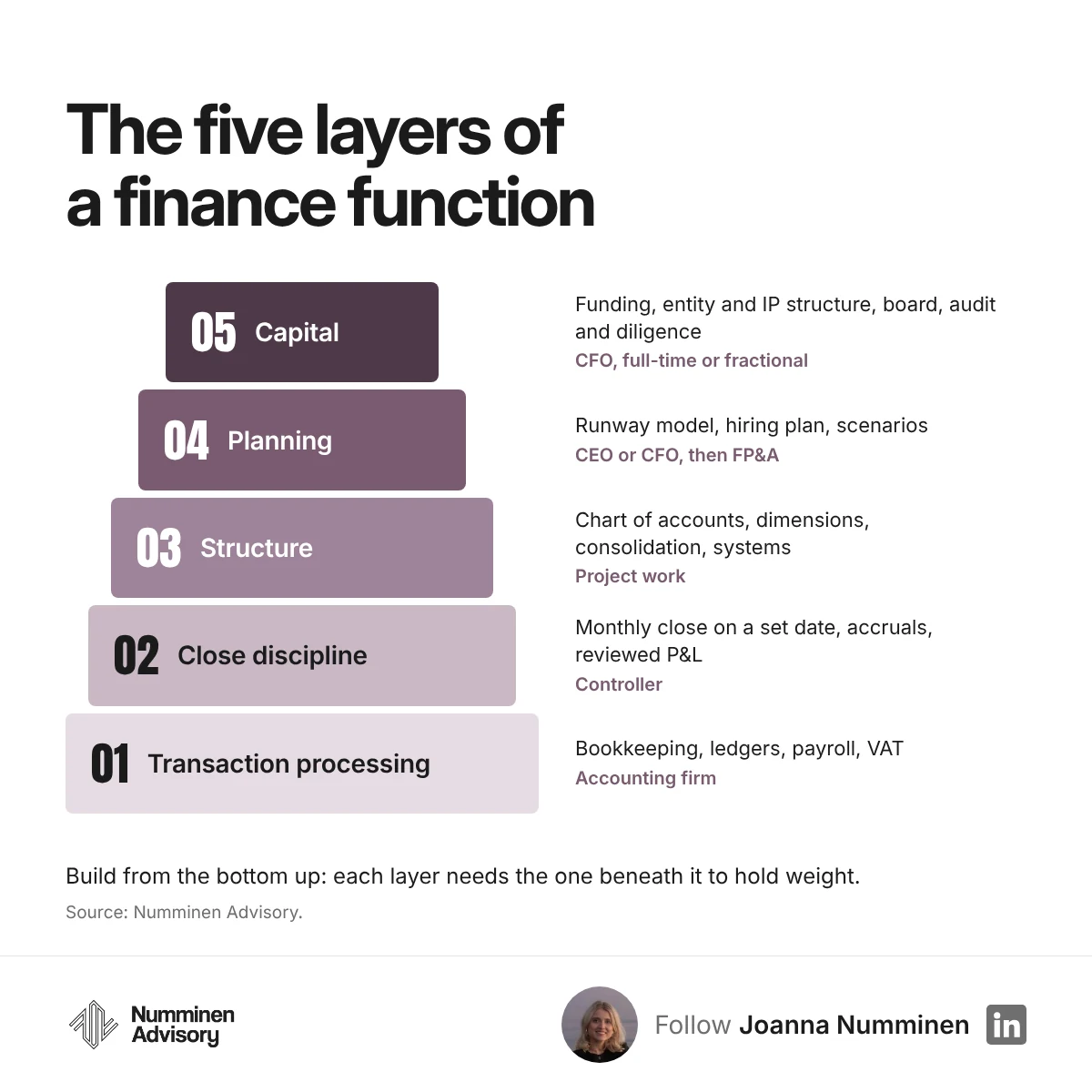
Layer 1. Transaction processing
What it is. Bookkeeping, the purchase and sales ledgers, payroll, VAT and statutory filings.
Who does it. An accounting firm, for longer than most founders expect.
What it costs. Mostly a function of transaction volume and the number of entities, so ask for pricing per entity.
When to change it. When your accounting firm starts slowing down the information you need. That usually shows up as management figures arriving on the twentieth of the following month.
The mistake at this layer is hiring an in-house bookkeeper too early because the accounting firm is annoying. The annoyance is usually a specification problem, and a better brief to the firm fixes most of it.
Layer 2. Close discipline
What it is. A monthly close that lands on a predictable date and produces a management P&L someone has reviewed before it goes out, with accruals and cut-off handled properly.
Who does it. A controller, or a finance manager (talouspäällikkö) if you also want someone owning process.
What it costs. Duunitori’s salary data, based on Statistics Finland figures for 2024, puts the average controller salary at €4,806 a month and the average talouspäällikkö at €5,695 a month, before employer costs.1, 2
Trigger. You have started making decisions every month, or an investor has started asking for figures on a schedule.
This is the layer everything else stands on. A forecast built on a close you do not trust is theatre, and a board pack built on it is worse, because it is persuasive theatre.
Layer 3. Structure that survives growth
What it is. A chart of accounts designed for the company you will be in two years, cost centre and project dimensions, a consolidation method that goes beyond a manually maintained spreadsheet, and a system stack that can carry a second entity.
Who does it. This is project work with a defined end.
Trigger. The second entity, the first grant with allocation requirements, or the first time someone asks for revenue split by something your ledger cannot produce.
The mistake here is buying the system before designing the structure. An ERP implemented on top of an undesigned chart of accounts is an expensive way to make the same mess faster, and it is very hard to unwind.
Layer 4. Planning
What it is. A model somebody owns, covering runway, the hiring plan, scenarios and the link between the operating plan and the cash position.
Who does it. At first the CEO or the CFO. An FP&A analyst comes in once the assumptions are stable enough for someone to maintain the model.
Trigger. The first time a board conversation turns on a projection.
Analysts are good at maintaining assumptions and should not have to source them, which is why hiring an analyst to own a model that nobody has defined tends to go badly.
Layer 5. Capital and structure
What it is. Funding strategy across equity, debt and non-dilutive sources, entity and IP structure, investor and board relations, audit and diligence readiness, and exit preparation.
Who does it. A CFO. Whether that is a full-time hire or a fractional arrangement depends on how much of this work there is.
What it costs. The average talousjohtaja salary in Finland is €9,823 a month (Duunitori, Statistics Finland data for 2024).3 Statutory employer contributions add about 20 percent of salary in 2026, and once holiday bonus, paid sick leave and occupational healthcare are counted, the real employer cost is closer to 30 to 34 percent.4 A full-time CFO at that average therefore costs roughly €12,800–13,200 a month. I show the full calculation in my note on Finland’s interim market survey. Executive search firm Operaria puts a typical leadership recruitment in technical industries at about 6–12 weeks, and the candidate’s notice period comes on top of that.5
Trigger. A round, an audit, a second country, or a grant portfolio large enough to carry real compliance exposure.
Four inversions worth naming
Senior finance before a reliable close. This is the most expensive inversion. You pay CFO money for six months of remedial controller work, and the person leaves, because that is not the job they took.
Systems before structure. The tell is a system selection process running before anyone has written down what the reporting needs to produce.
Headcount before scope. Two junior finance hires often solve less than one correctly specified role plus a better brief for the accounting firm.
Consolidation handed to your auditor’s firm. It is convenient and cheap, and it creates an independence problem the moment the group matters enough to be audited properly, because the auditor ends up reviewing work its own firm produced. Build consolidation in-house, or buy it from someone independent of your auditor. The group consolidation page describes how I approach it.
The eighteen-month question
Almost none of this needs to happen at once, and the sequence differs by company. A single-entity SaaS business heading into a Series A builds a different function from a three-entity hardware group with a Business Finland loan and a US subsidiary.
The question worth answering properly is what finance needs to look like in eighteen months and in what order to get there, including which parts to hire and which to outsource. It takes a few days to answer well and costs considerably less than answering it wrong.
Bottom line
You do not need the whole finance function at once. You need the right layer at the right time, built on the one beneath it.
Build in order. Transaction processing, close discipline, structure, planning and capital, each one only once the layer below it can hold weight.
Get the close right first. A reliable monthly close is the foundation for every forecast, board pack and funding conversation that follows. Hire a controller before senior finance.
Design before you buy. Settle the chart of accounts, dimensions and consolidation method before choosing a system.
Bring in a CFO for capital decisions. A round, an audit, a second country or a significant grant portfolio is the point where capital and structure need an owner. How much of that work there is decides whether the role should be full-time or fractional.
Plan eighteen months ahead. Decide what finance needs to look like by then, in what order to build it, and which parts to hire and which to outsource.
References
- Duunitori. Controller palkka. Statistics Finland wage data for 2024.
- Duunitori. Talouspäällikkö palkka. Statistics Finland wage data for 2024.
- Duunitori. Talousjohtaja palkka. Statistics Finland wage data for 2024.
- Finnish Centre for Pensions (ETK). Statutory social insurance contributions in Finland in 2026. January 2026.
- Operaria. Kuinka pitkä prosessi johdon rekrytointi yleensä on?. 24 April 2025.