



In brief
Financial due diligence in a Series A or B round tests whether a company’s numbers can be reproduced from its systems by someone who does not trust them. Investors check six areas: the historical accounts and close, revenue and its definitions, cash and the forecast, the group structure, tax and public funding, and ownership. Preparation should start about four months before the first investor meeting.
Most checklists for financial due diligence are written for acquisitions, where a buyer’s accountants spend weeks inside a mature company. A Series A or B round is different. The investor’s team is smaller, the timeline is shorter, and the question they are answering is narrower: can the numbers in the pitch be traced back to the ledger, and will they still hold when the company is twice the size?
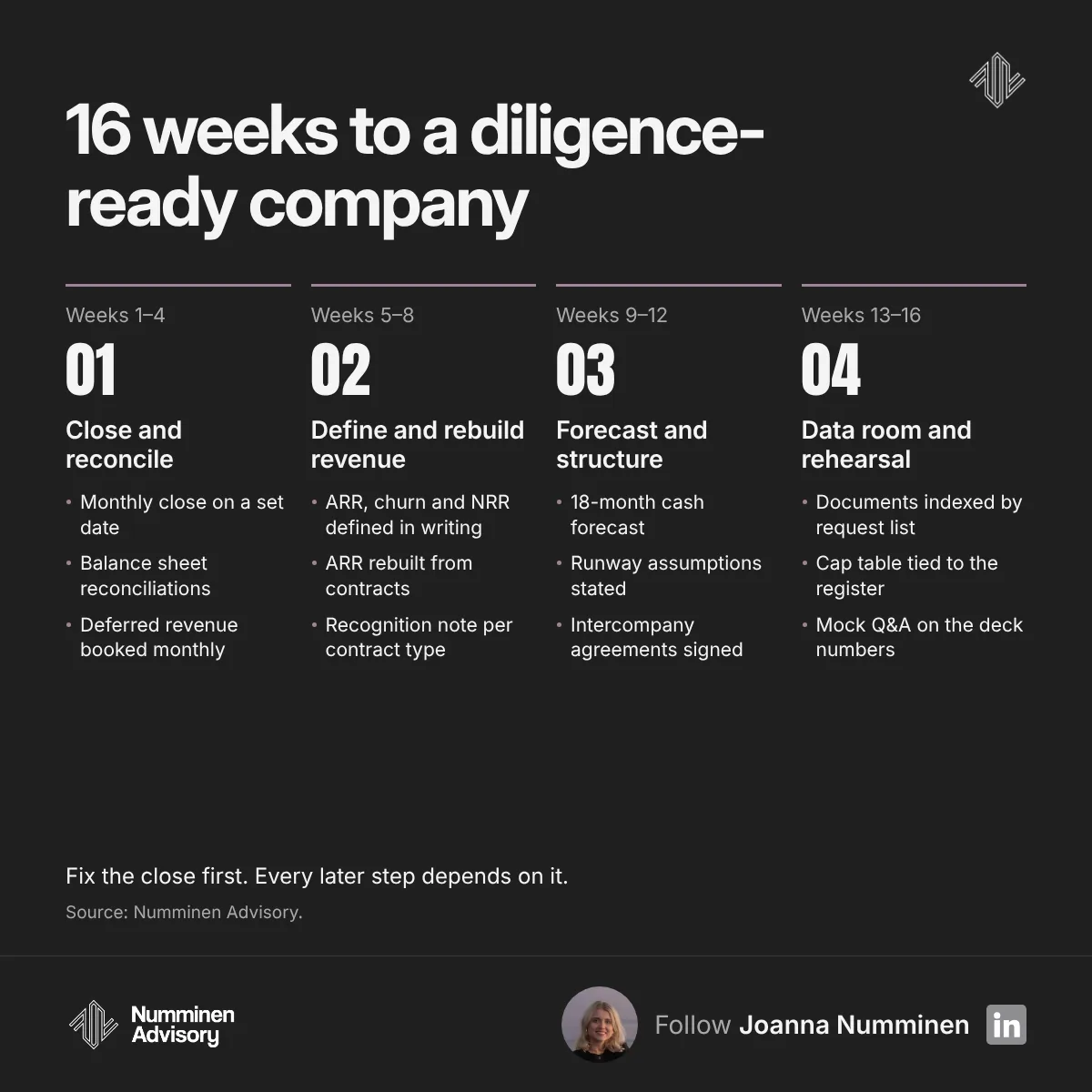
I have prepared companies for venture capital due diligence and for an acquirer’s financial due diligence, and the specifics are best discussed in confidence, so get in touch if you want to hear how it went in practice. What follows is the preparation I ask founders to start four months before a round.
What investors are really testing
Diligence in a funding round is rarely an audit. Nobody re-performs your bookkeeping. The investor’s finance team, or an outside firm working for them, picks a handful of numbers from your deck and asks you to show where each one comes from. Annual recurring revenue, gross margin, burn and runway are the usual candidates.
When the answer is a reconciled report out of the accounting system, the questions move on quickly. When it is a spreadsheet that only one person understands, the questions multiply, and the term sheet timeline starts to slip.
The checklist
The same list comes as a working file with owner, status and data room columns, either as a Google Sheet you can copy or as an Excel download. Use it to track who prepares each item and where it sits in the data room.
1. Historical accounts and the monthly close
Annual accounts for the last two or three financial years, with the auditor’s report where one exists.
Monthly management accounts for the last 12 to 24 months, built from the same ledger as the annual accounts.
A monthly close that finishes on a set date, ideally within ten working days of month end.
Balance sheet reconciliations for cash, receivables, payables, accruals and deferred revenue, signed off each month.
A short note on any restatements, unusual items or one-off costs, with the reason for each.
2. Revenue and its definitions
A written definition of every revenue metric in the deck, including ARR, MRR, bookings, net revenue retention and churn.
ARR rebuilt customer by customer from signed contracts, reconciling to recognised revenue in the ledger.
A revenue recognition note for each contract type, covering subscriptions, implementation fees, usage-based charges and multi-year deals.
The share of revenue coming from the top five and top ten customers.
Cohort data showing retention and expansion over time, built from billing data that ties to the ledger.
3. Cash, burn and the forecast
A monthly cash forecast for at least 18 months, starting from the actual bank balance.
Burn rate and runway, with the two or three assumptions they depend on stated in writing.
The hiring plan behind the forecast, by month and role.
A scenario that shows what happens if the round closes three months later than planned.
4. Group structure and intercompany
A legal structure chart showing every entity, its country, its ownership and what it holds: employees, IP, contracts and cash.
Signed intercompany agreements for services, licences and loans, with pricing that matches what is booked.
Transfer pricing documentation, or a clear note on why the group is below the documentation threshold.
Consolidated figures for the group, with eliminations shown, if the deck presents group numbers.
5. Tax, grants and public funding
Corporate income tax and VAT filings for each entity, with any correspondence from tax authorities.
Grant and loan agreements from Business Finland, the EU or other public funders, including repayment and reporting conditions.
A written policy on capitalising development costs, applied the same way every year.
Any open tax positions or disputes, with an estimate of exposure.
6. Ownership, contracts and commitments
A cap table that ties to the official share register, including all option grants and convertible instruments.
The option plan documents and every grant letter.
The top 20 customer and supplier contracts, with change-of-control and exclusivity clauses flagged.
Debt, leases and other commitments, with covenant terms summarised.
When to start
Four months before the first investor meeting is about right for a company with one entity and a working monthly close. Add time for each additional entity and each accounting framework the group reports under, because consolidation and intercompany questions take the longest to answer well.
The order matters. Fix the close and the reconciliations first, since every later step depends on them. Then write the revenue definitions and rebuild ARR from contracts. Build the forecast on top of clean actuals. Assemble the data room last, once the documents in it can be trusted.
The findings that slow rounds down
Five issues come up again and again when I review a company before a raise.
ARR that does not reconcile. The deck figure was built from the CRM and nobody has tied it to recognised revenue. The fix is a customer-level bridge between the two, updated monthly.
Deferred revenue that only exists in a spreadsheet. Annual prepayments are booked as revenue on invoice, and the adjustment is made by hand at year end. Investors will ask for the monthly view.
Intercompany balances that do not match. The Finnish parent shows a receivable from the US subsidiary that differs from the payable on the other side. Each mismatch raises a question about whether the consolidated numbers can be trusted.
Grant conditions nobody has read. Public funding often carries reporting duties, cost eligibility rules and, in some cases, repayment conditions linked to ownership changes. An investor needs to know before they invest.
A cap table that disagrees with the register. Small differences in option grants or share classes take lawyers’ time to resolve, and they surface late.
Where AI helps, and where it does not
Much of diligence preparation is matching: each investor request against the documents in the data room, each intercompany line against its counterpart, each ARR line against a contract. At Numminen Advisory this is work that AI agents now prepare, checking requests against the data room index and drafting a first answer from the ledger. What gets released to an investor, and how a finding is explained, stays with the CFO.
Bottom line
A Series A or B diligence goes well when every number in the deck can be traced to the ledger in minutes. Start four months ahead, fix the close before anything else, and write down your definitions before an investor asks for them. If a round is on the horizon, our funding and diligence readiness work starts with a review of exactly this list.