



In brief
What changes: a second legal entity turns a company into a group, with a monthly consolidation, an arm’s length price on every intercompany transaction, local payroll and tax, currency effects in group equity and up to three accounting frameworks. Why act early: the structure takes perhaps a week to design before the entity exists and becomes a project after two years of history. What to do: settle eight points before the certificate arrives and keep consolidation independent of your auditor.
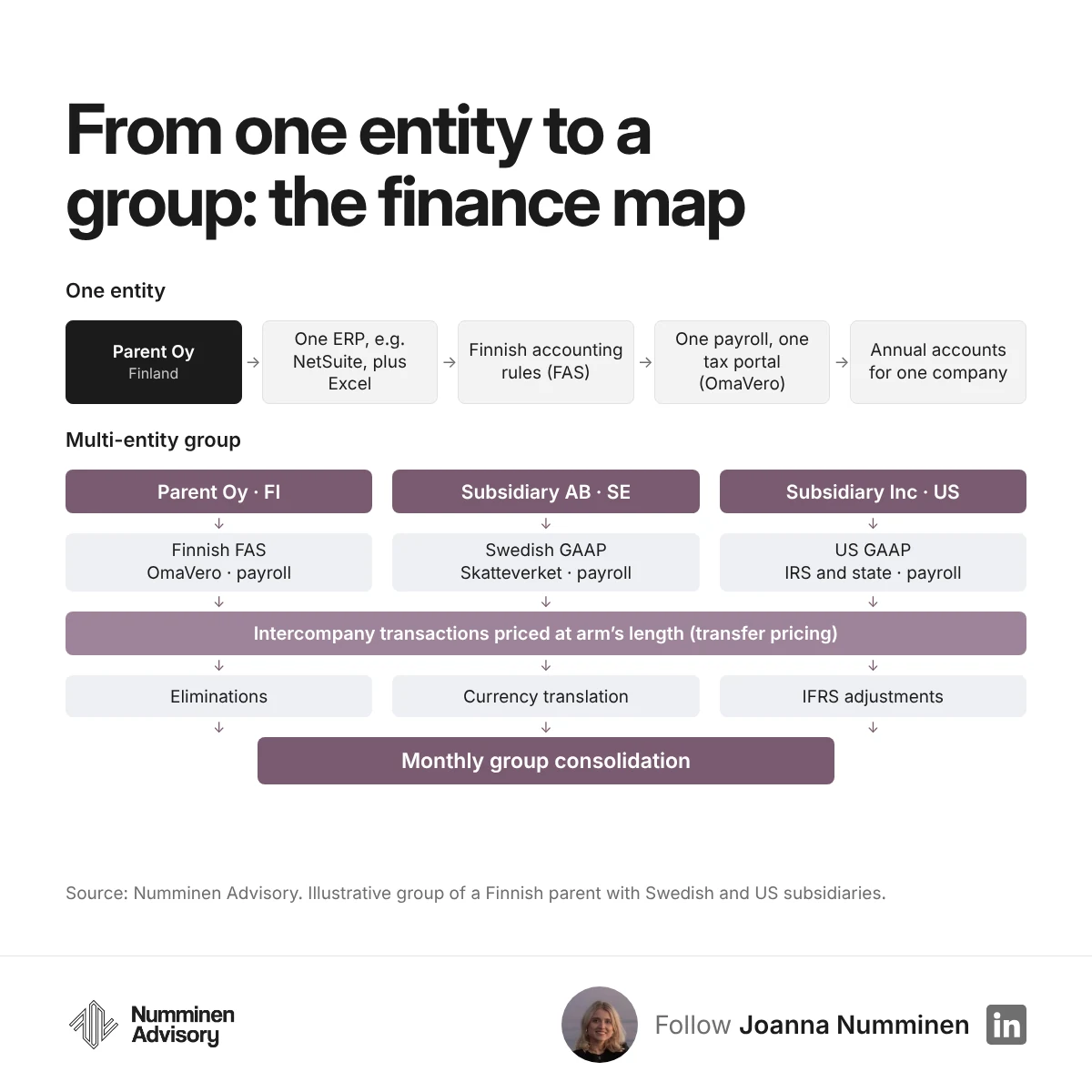
Setting up a second legal entity, usually a foreign subsidiary, is the sharpest dividing line in a growth company’s finance function. From that point the company is a group, with intercompany transactions to price at market terms, consolidation to run, local payroll and tax to manage, and often two or three accounting frameworks running at once. The work starts before the entity exists and never stops.
Most Finnish technology companies incorporate abroad for a commercial reason. A customer requires a local contracting party, or a salesperson needs an employment contract. Sometimes an investor wants a US holding structure. The decision gets made in a board meeting, handed to a law firm and closed a few weeks later when the certificate arrives. Finance usually hears about it afterwards.
What changes when you have a group
You now have a group to consolidate. Two sets of books have to be added together and then partly subtracted from each other. Intercompany balances must agree in both ledgers to the cent, even though each side was posted by different people in different systems on different days. Eliminations have to be repeatable every month.
Finnish law lets a parent skip consolidated financial statements when the group is small, meaning it exceeds at most one of three limits: a balance sheet of €7.5 million, turnover of €15 million, or an average of 50 employees.1 The exemption removes a filing obligation and leaves everything else in place.2 Your board and investors still need to see the group, and a future acquirer will want three years of group history produced consistently.
Transactions between your companies need a price. The moment your Finnish company does something for your foreign company, or the reverse, that transaction has to be priced as if the two were unrelated parties. Two separate obligations get conflated here. The obligation to price at arm’s length applies at any size. The obligation to keep formal transfer pricing documentation depends on size, and in Finland a company that meets the EU definition of a small or medium-sized enterprise is exempt from it. That means fewer than 250 employees and either turnover of at most €50 million or a balance sheet of at most €43 million.3 The Tax Administration’s guidance is explicit that the relief stops at documentation, because the arm’s length principle “is applied in the same way to all transfer pricing cases.”
Founders hear “we’re too small for transfer pricing” from someone who meant the documentation, and conclude the pricing does not apply either. A tax auditor reviewing an intercompany recharge four years later will want to know whether the price was defensible. The practical fix is a two-page document, written before the first invoice, setting out what each entity does for the other and on what basis. The transfer pricing page covers how that document turns into monthly bookkeeping.
Permanent establishment risk often arrives before the entity does. It frequently starts with a salesperson who has been closing deals from another country for eight months, and the incorporation is the response to a problem that has already been running. Under the OECD model tax treaty, a person who habitually concludes contracts for a company in another country, or habitually plays the principal role in concluding them, can create a taxable presence there, although the exact test depends on the treaty between the two countries.4 If you are incorporating because someone is already there, start by looking at what happened in the months before the new entity existed.
Payroll becomes local. You need local employer registration and social security arrangements, and a payroll calendar that does not line up with your Finnish one. Employees who work in another EU country need an A1 certificate showing which country’s social security covers them, and in Finland the Finnish Centre for Pensions issues it.5
You may now have two functional currencies. Under IFRS, a foreign subsidiary’s assets and liabilities are translated at the closing rate, its income and expenses at the rates on the transaction dates, and the resulting differences go to other comprehensive income.6 A subsidiary operating in dollars and consolidated into a euro parent will therefore move group equity for reasons unrelated to performance. The first time this appears in a board pack, someone will ask why equity changed when nothing happened, and someone should be ready with the answer.
Two frameworks, sometimes three
Your Finnish entity reports under Finnish accounting rules because Finnish law and the tax authority require it, and your subsidiary reports under its own country’s framework for the same reason. If your investors or an eventual acquirer are international, you will also be asked for IFRS, or for US GAAP when the counterparty is American. That can mean three frameworks running concurrently off one set of transactions, and the differences that bite a technology company are specific and predictable.
Development costs. Under IFRS, research is expensed and development spending that meets specified criteria is recognised as an intangible asset.7 Under US GAAP, research and development costs are generally expensed as incurred, with separate rules for software.8 Finnish rules allow development costs to be capitalised, and the amount not yet written off cannot then be distributed as profit.9 The same engineering spend can legitimately be an asset in one set of accounts and a cost in another, and EBITDA moves with it. If nobody has decided which number the company manages against, it ends up managing against whichever one was produced most recently.
Government grants. This matters if you carry external funding. Under IFRS, grants fall under IAS 20, which also treats the benefit of a below-market-rate government loan as a grant.12 US GAAP had no dedicated standard for business entities until the FASB issued one on government grants in December 2025, and that standard leaves below-market-rate loans outside its scope.10 Grants are often large enough to change how a period reads.11
Leases. IFRS 16 requires a lessee to recognise a right-of-use asset and a lease liability for leases longer than twelve months unless the asset is of low value.13 Under Finnish accounting practice, lease payments are generally expensed.14 If your office lease is significant, your group balance sheet under IFRS looks different in ways that can affect covenant calculations and any multiple applied to it.
Revenue recognition, at least, is largely aligned. IFRS 15 and the US standard, ASC 606, remain substantially converged, although some differences exist.15
You do not need three sets of books. You need one set of underlying data, structured so that three views can be produced without three months of manual work, and that structure is a design decision you make once.
Why “our accounting firm will handle it” runs out
It is the natural answer, and it works for a while. Two problems arrive later.
The first is timing. An accounting or audit firm building your consolidation usually treats it as a year-end exercise, so group numbers appear once a year, months after the year ends. That is adequate for filing. Running a company or populating a data room needs the group position every month.
The second is independence. If your audit firm builds the consolidation, it later audits its own work. That is manageable while the group is small and becomes a real problem exactly when the group starts to matter, so build the capability internally, or buy it from someone independent of your auditor, and do it deliberately.
The cost of doing it late
Diligence typically looks back two to three years. If your group only consolidated properly from year three, you will rebuild years one and two under time pressure, from records never designed to be assembled that way, while answering hundreds of other questions.
The design work itself, meaning a chart of accounts with an entity dimension, an intercompany account structure, elimination logic and a group close calendar, takes perhaps a week when there is no history. After two years of transactions it becomes a project, running at the same time as something more important. The group consolidation page sets out what that project covers.
Eight things to settle before the certificate arrives
- Why this entity exists, in one sentence. Sales, employment, IP, a customer requirement or an investor structure lead to different answers for everything below.
- What it will own. Which assets it will hold, such as IP or customer contracts, and explicitly what stays with the parent.
- How it is funded. Equity, an intercompany loan or recharges each carry different tax and currency consequences, loans can raise thin capitalisation questions, and changing the choice later is harder than making it now.
- The intercompany model. What it charges and is charged, on what basis, in which currency and on what cycle, in two pages written before the first invoice.
- Functional currency, and which entity carries the currency exposure.
- Reporting calendar. A financial year end aligned with the parent’s unless there is a reason otherwise, local statutory deadlines mapped, and one group close date everyone works to.
- Chart of accounts. The same structure in both entities with an entity dimension, plus a deliberate decision on whether consolidation happens inside the accounting system or outside it. That decision is the most expensive one to reverse.
- Who is accountable locally. Who holds director duties and signing authority there, and who actually files what.
None of this needs to delay the incorporation, because it can run in parallel. The mistake is doing it in sequence, with the legal work first and finance told afterwards, so the structure gets inherited by default.
The certificate takes days. The structure lasts until someone buys you.
Bottom line
A second legal entity turns a company into a group, and the finance function changes with it: a consolidation to run every month, an arm’s length price on every intercompany transaction, local payroll and tax, possible permanent establishment exposure, currency effects in group equity, and up to three accounting frameworks running off one set of transactions. All of it is straightforward to design before the entity exists and expensive to rebuild after two years of history. Settle the structure before the certificate arrives, run that work in parallel with the legal work, and keep the consolidation independent of your auditor.
General observations, not tax or legal advice for any particular situation. Thresholds, exemptions and framework requirements change, and the right answer depends on the jurisdictions involved.
References
- Kirjanpitolautakunta. Konsernikokorajojen arvioimisesta. Statement 2101, 25 February 2025.
- Kirjanpitolautakunta. Konsernitilinpäätöksen laatimisvelvollisuudesta. Statement 2110, 8 April 2025.
- Verohallinto (Finnish Tax Administration). Transfer pricing documentation. 28 April 2022.
- KPMG in India. OECD BEPS Action 7: Preventing the Artificial Avoidance of Permanent Establishment Status. 3 November 2015.
- Finnish Centre for Pensions (ETK). What is an A1 certificate.
- IFRS Community. Effects of Changes in Foreign Exchange Rates (IAS 21). Updated 14 May 2025.
- IFRS Foundation. IAS 38 Intangible Assets.
- KPMG. R&D costs: IFRS Accounting Standards vs. US GAAP. 13 March 2025.
- Kirjanpitolautakunta. Taseeseen aktivoitujen kehittämismenojen merkityksestä osakeyhtiölain 12 luvussa säädetyn pääomalainan pääoman palautukselle ja koron maksulle. Statement 2143, 9 June 2026.
- IFRS Community. Government Grants, Government Assistance (IAS 20). Updated 17 May 2024.
- Crowe. FASB Issues Final ASU on Government Grants for Businesses. 12 December 2025.
- IFRS Foundation. IAS 20 Accounting for Government Grants and Disclosure of Government Assistance.
- IFRS Foundation. IFRS 16 Leases.
- Azets. Vuokrasopimusten aktivointi IFRS 16 mukaan. 19 May 2024.
- KPMG. Revenue accounting: IFRS Accounting Standards vs US GAAP. Updated 16 September 2026.