

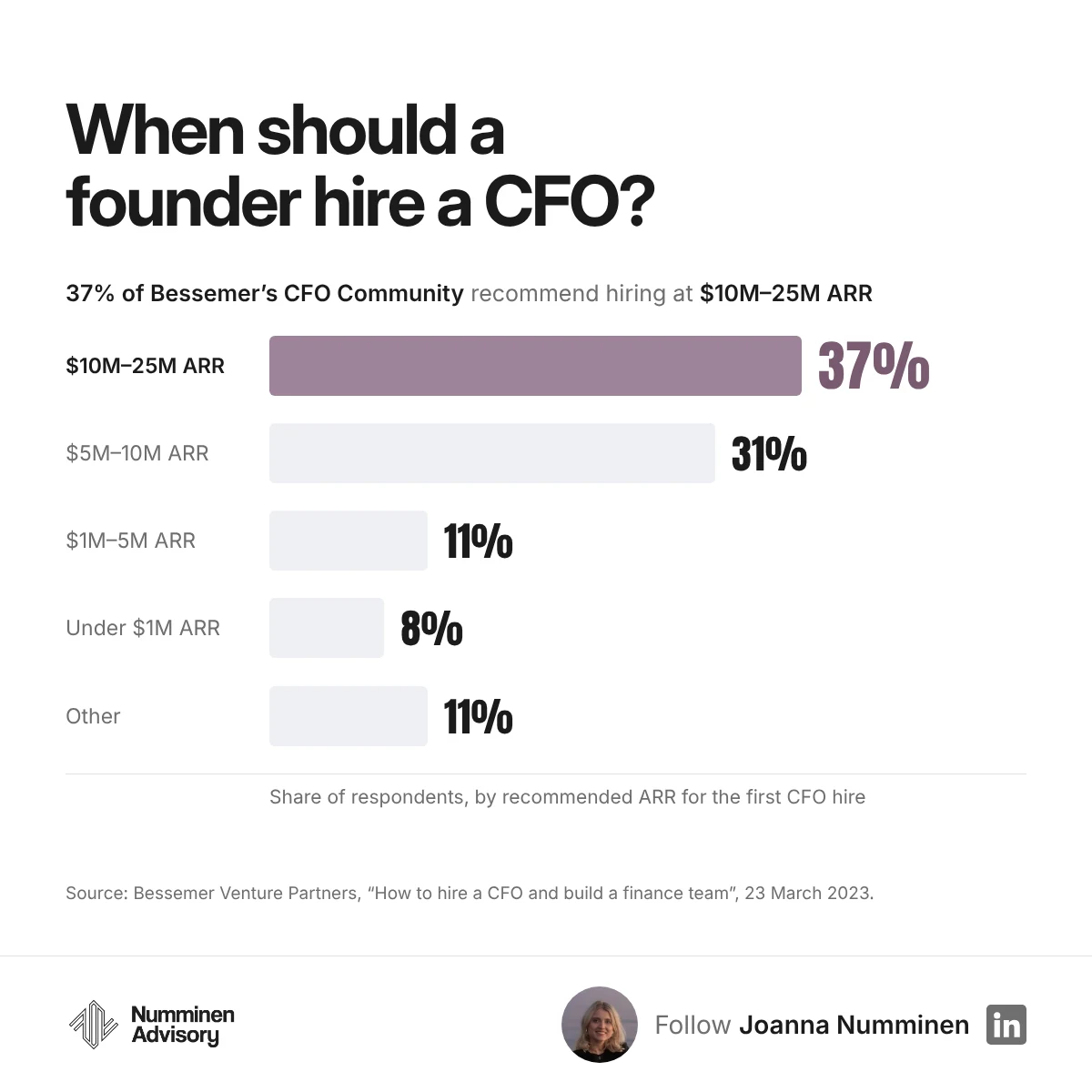
Most growth companies do not need a CFO until one of four things happens: an institutional funding round, a first audit, a second legal entity, or public funding large enough to carry real compliance exposure. Each of those changes the structure of the business, and structure predicts the need for senior finance better than headcount or revenue.
Over the past 15 years I’ve built finance functions for startups and technology companies of different sizes. I’ve seen companies make mistakes by hiring CFOs too late, or too early. Now, as a fractional CFO, I can give objective advice to entrepreneurs without long-term commitments. Here is my honest take on when you should hire your first CFO.
What does a CFO actually do?
Most of the confusion comes from one title covering four different jobs in four different company sizes. Closing the books belongs to a controller or your accounting firm. So do payroll and VAT returns. The budget spreadsheet can be built by someone else too, although a CFO will own the assumptions inside it.
A CFO exists to make decisions about capital: where it comes from, what it costs, how long it lasts, and what the company has to look like structurally before someone will give you more of it. Everything else on the finance org chart supports that job.
When nobody in your company is making decisions about capital, either there are none to make or they are being made by accident. Those two situations call for very different responses.
Five questions that tell you whether you need one yet
Answering these from memory, on a Tuesday, without opening a file, means you do not need a CFO yet.
- How many months of runway do you have, and which two assumptions does that number depend on? The assumptions matter more than the number. Most runway figures rest on one hiring plan and one revenue timing assumption, and the CEO is usually the only person who knows which two.
- What has to be true financially for your next round to close at the valuation you have in mind? Name the metric, the level and the month. A qualitative answer means the round is hoped for rather than planned.
- Which of your legal entities holds what, and why? Think of IP, contracts, employees and cash. With one entity this question is free. With three, leaving it unanswered gets more expensive every quarter.
- What would an auditor or an acquirer find in their first week? It is enough to know whether you would be surprised.
- Does the number your board sees mean the same thing as the number your bank sees? Someone should be able to reconcile the two in under an hour.
A controller and a decent accounting firm who can answer all five between them add up to a functioning finance function. Adding a CFO on top will produce good conversations and very little else, so spend the money on the product.
The four triggers that change the answer
An institutional round. Diligence is a stress test of whether your numbers were ever built to be examined by someone who does not trust you. The cap table, the forecast, revenue recognition and the contracts all get tested. Somebody has to own that work, and it cannot be the person who is also closing the month.
Your first audit, or a change of auditor. The gap between books that are broadly right and books that survive an audit is larger than almost every founder expects, and the work to close it happens months before the auditor arrives. A Finnish company can skip the statutory audit only if, in both of its last two financial years, it exceeded at most one of three limits: a balance sheet of €100,000, turnover of €200,000, or an average of three employees.1 Investor-backed companies usually cross that line within their first couple of years. I cover the preparation on the audit readiness page.
Your second entity. This is the sharpest line on the list. A second country means consolidation, intercompany balances, transfer pricing and often two accounting frameworks running at once, which is why I think of the second entity as the line where finance becomes a technical function.
Public funding at scale. A Business Finland or EU project brings eligibility rules and reporting obligations that have to be designed into your accounting from the start. Business Finland’s current R&D funding terms require project accounting in which each project cost can be identified and traced back to the books, and allow the funder to reject costs when that is not in place.2 Retrofitting that structure afterwards is where the money gets lost.
None of these says “you have reached €X of revenue.” I have seen a €3M company with three entities and a grant portfolio that badly needed senior finance, and a €12M single-entity business that did not.
If none of the triggers apply
The useful question then becomes what your finance function should look like in eighteen months, and in what order to build it. That is a sequencing question with a right answer for your situation, and I have set out the order I use separately.
Hire the controller first, almost always. The most common expensive mistake I see is a company hiring senior finance into a function with no reliable monthly close, which leaves a well-paid person spending their first six months on work two levels below their title.
How a CFO supports your go-to-market
Sales and marketing are often among the largest investments a growing company makes, and the ones where the link between money spent and revenue earned is hardest to see. That makes go-to-market one of the places where a CFO adds the most value, and one where finance is most often left out until the annual budget review.
The pattern I see most often is a sales plan and a finance plan built separately. Sales leadership commits to a revenue target and asks for the headcount to reach it. Finance receives the hiring plan, costs it and checks it against runway. Nobody owns the assumptions that connect the two: how long a new salesperson takes to ramp up, how much pipeline each one needs to reach quota, what share of that pipeline marketing has to generate, and how long a deal takes to close and turn into cash.
Three areas work best when sales and finance leadership build them together.
Pipeline investment. Marketing spend is a bet on future pipeline, and in B2B it pays back over a sales cycle that can run for many months. Finance should help define what a qualified opportunity is worth and how much the company can afford to spend generating one, so the marketing budget is sized against the pipeline it needs to produce rather than against last year’s spend.
Sales recruitment. Every new seller is a full salary for months before they bring in revenue. Hiring ahead of pipeline burns runway, and hiring behind it caps growth. The CFO’s job is to make that timing explicit, tie each hire to the pipeline coverage that justifies it, and agree in advance what would trigger a pause or an acceleration.
The forecast. A revenue forecast built only from the CRM tends to be optimistic, and one built only from a top-down finance plan tends to ignore what the sales team actually knows. The useful version combines both: weighted pipeline from sales, conversion rates and payment timing from finance, reviewed together every month and reconciled to cash.
When this works, the conversation between the CEO, the sales leader and the CFO moves from “can we afford more sellers?” to “what does the pipeline tell us about when to hire the next two?” That is a decision about capital, which is why it belongs with a CFO. An early-stage company does not need a full-time CFO to have it, but someone has to own the model that connects the go-to-market plan to the cash plan. By the time of an institutional round, investors will ask who that is.
The disclosure
I am a fractional CFO, and my incentive is to tell you that you need one. I have written the rule down because a decision rule you can check is worth more than an opinion you have to trust.
If you are within about twelve months of one of the four triggers, the sequencing question deserves an afternoon of proper thought. If you are not, come back when you are.
References
- Finlex. Tilintarkastuslaki 1141/2015, 2 luku 2 §. Consolidated version, 27 June 2025.
- Business Finland. Rahoitusehdot: yritysten tutkimus- ja kehitystoiminnan rahoitus. Effective 1 January 2026.