



In brief
The picture: Finland, Denmark and Sweden lead the EU in company AI use, but inside the finance function use is wide and shallow, and only one in five Nordic CFOs has high confidence in AI for decisions. Where the value is: speed, decision quality and forecast accuracy more than headcount savings. What holds teams back: poor data, low trust in outputs and missing in-house expertise. Where to start: forecasting and planning.
Nordic companies use AI more widely than almost anyone else in Europe. Inside the finance function the picture is more modest: most teams run pilots and assistants, few have AI in core processes, and the distance to large global finance functions lies mainly in depth of use.
Key takeaways
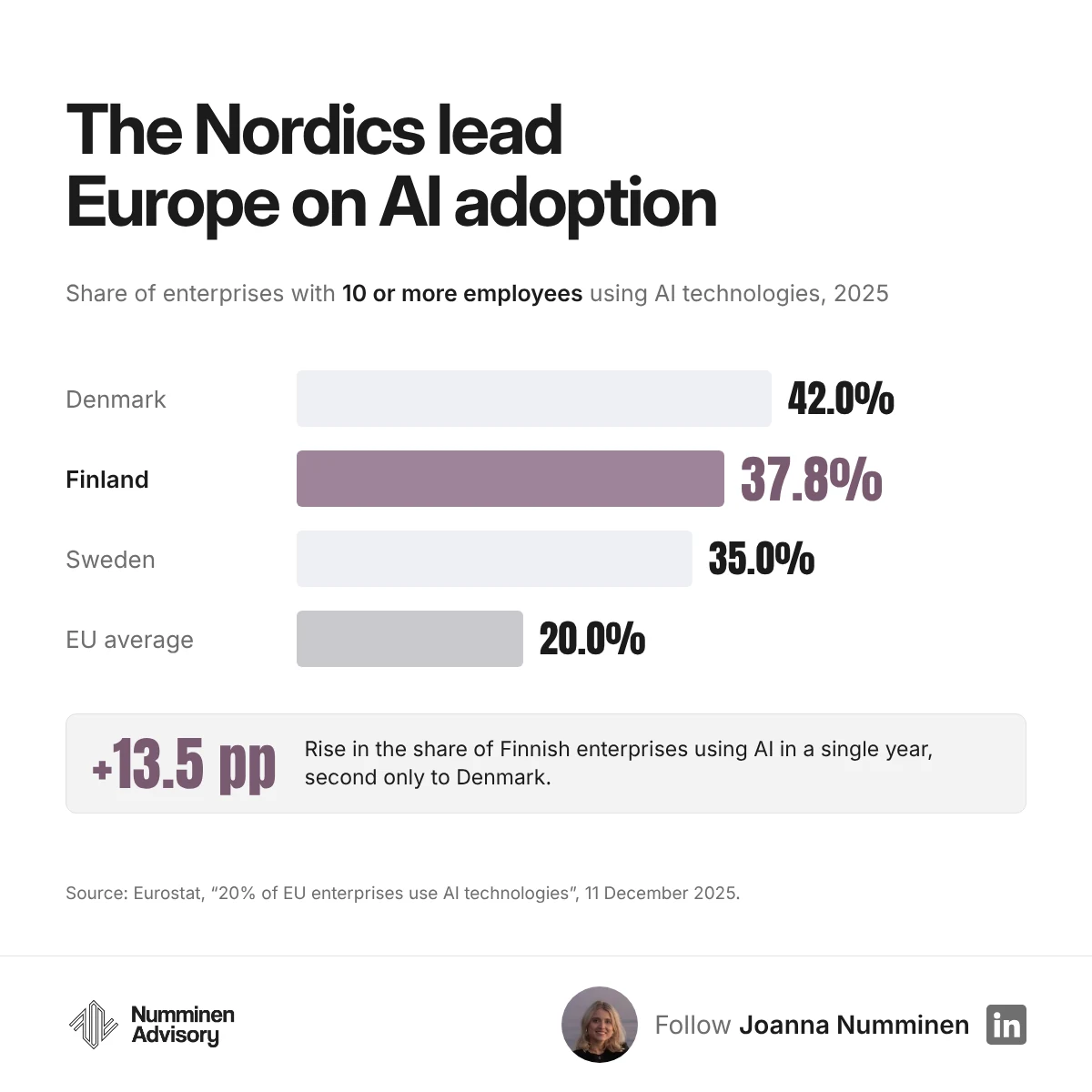
- Finland, Denmark and Sweden have the highest share of companies using AI in the EU, at 37.8%, 42.0% and 35.0% against an EU average of 20.0%.1
- Use is wide and shallow. Only 22% of Nordic organisations have moved 40% or more of their AI experiments into production.2
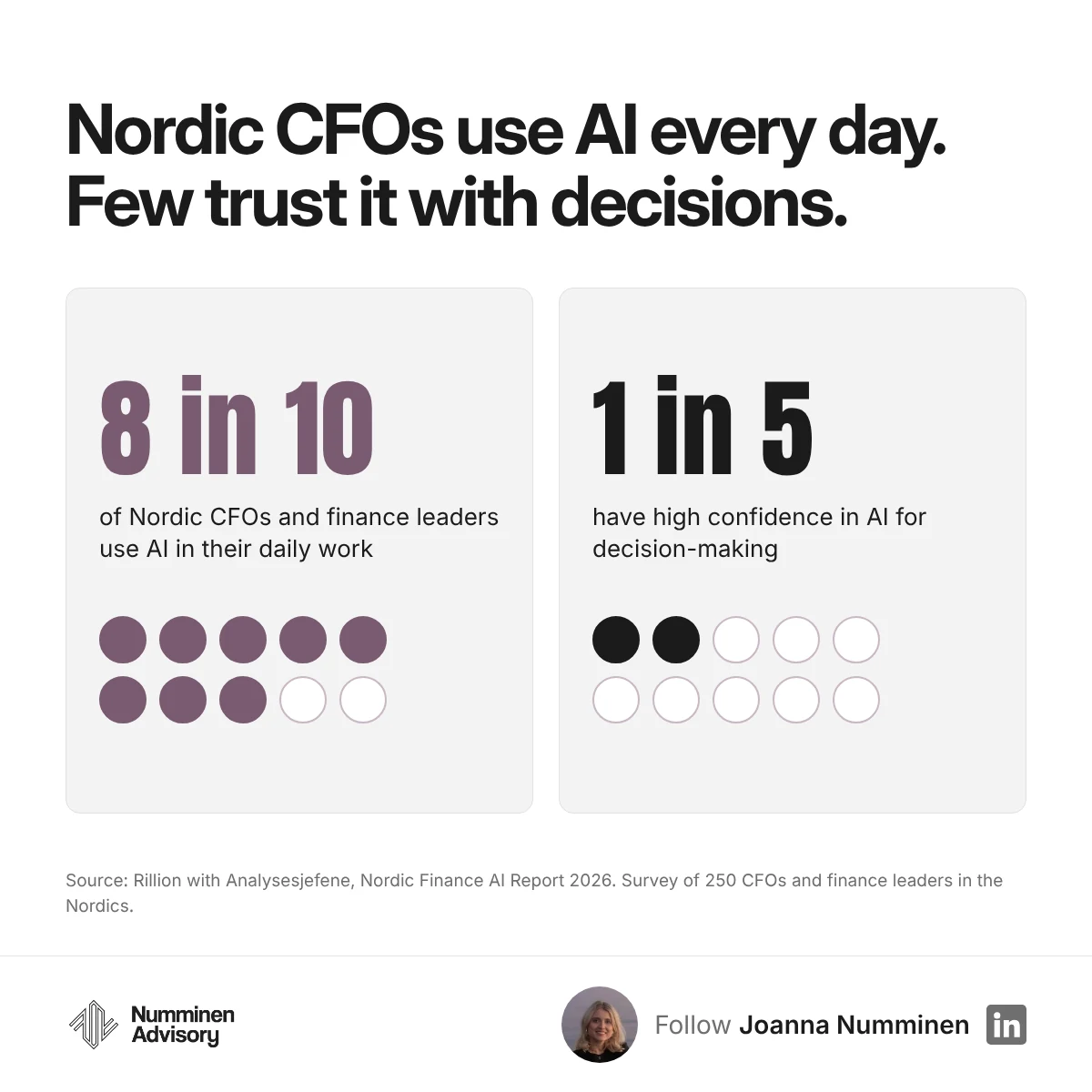
- 8 in 10 Nordic CFOs use AI in their daily work. One in five has high confidence in it for decision-making.3
- Globally, the returns show up in speed and decision quality more than in headcount savings.4, 5
- The main brakes in Nordic finance teams are poor data, low confidence in AI output and a shortage of in-house expertise.3, 6
How widely do Nordic companies use AI?
By the broadest measure, the Nordics lead Europe. Eurostat’s 2025 figures show that 20.0% of EU enterprises with 10 or more employees used AI technologies, up from 13.5% a year earlier.1 Denmark (42.0%), Finland (37.8%) and Sweden (35.0%) top the list, and Finland’s share rose by 13.5 percentage points in a single year.1
Statistics Finland reports the same jump from the national side: 38% of Finnish companies used AI technologies in spring 2025, 14 percentage points more than the year before.7 At that pace, about a third of the Finnish companies using AI took it up within the past year.
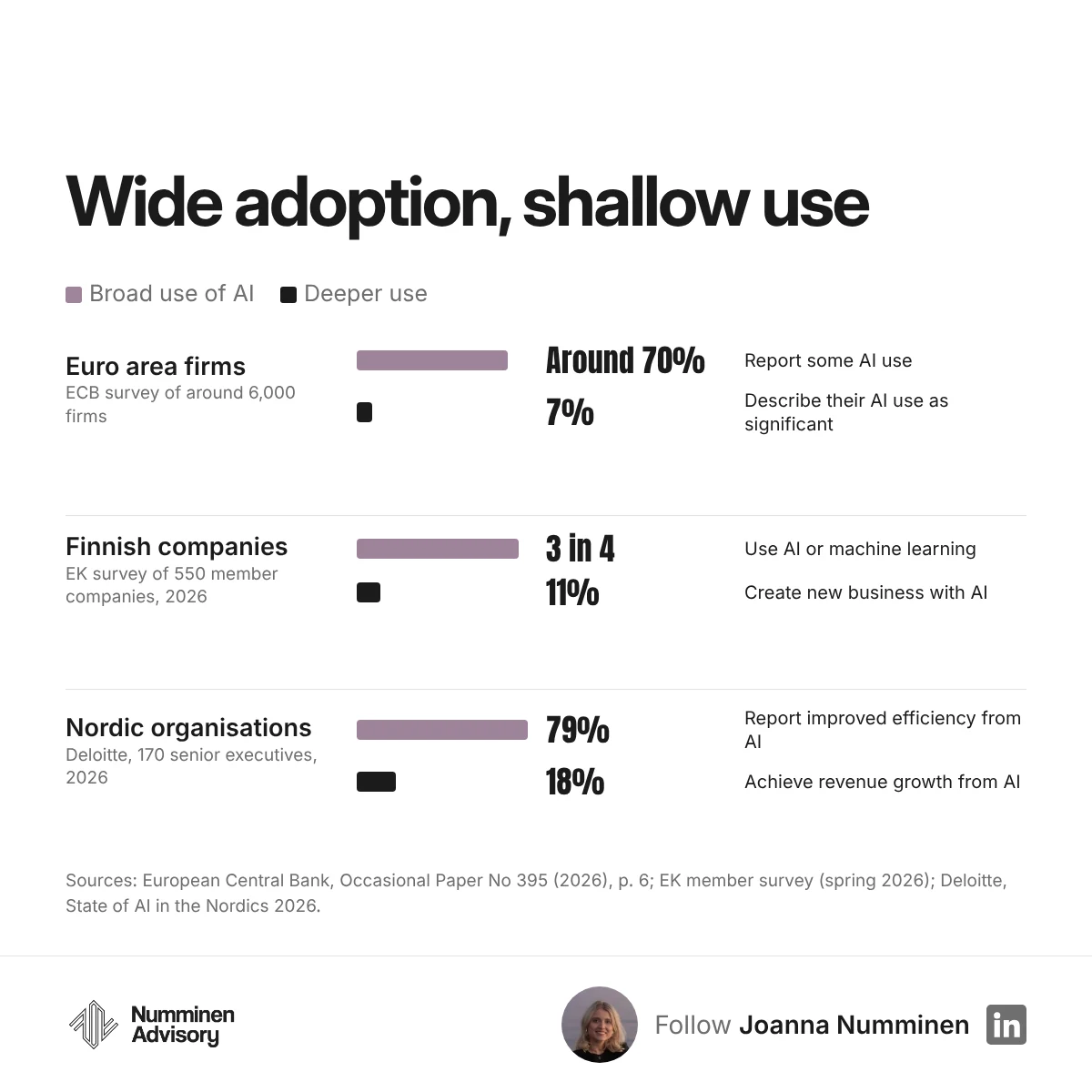
The European Central Bank’s survey of around 6,000 euro area firms asks the question more loosely and gets a higher number. Around 70% of euro area firms report some AI use, and Finland sits with the Netherlands and Austria among the countries where more than 80% of firms report some adoption.8
Wide adoption, shallow use
The same ECB survey carries the more telling figure. Of that 70%, only 7% describe their AI use as significant.8
Finnish data points the same way. In the Confederation of Finnish Industries’ spring 2026 survey of 550 member companies, three in four use AI or machine learning.9 Most of that use goes into what already exists, with 83% of AI users applying it to current processes. New business built on AI is reported by 11% of respondents.9
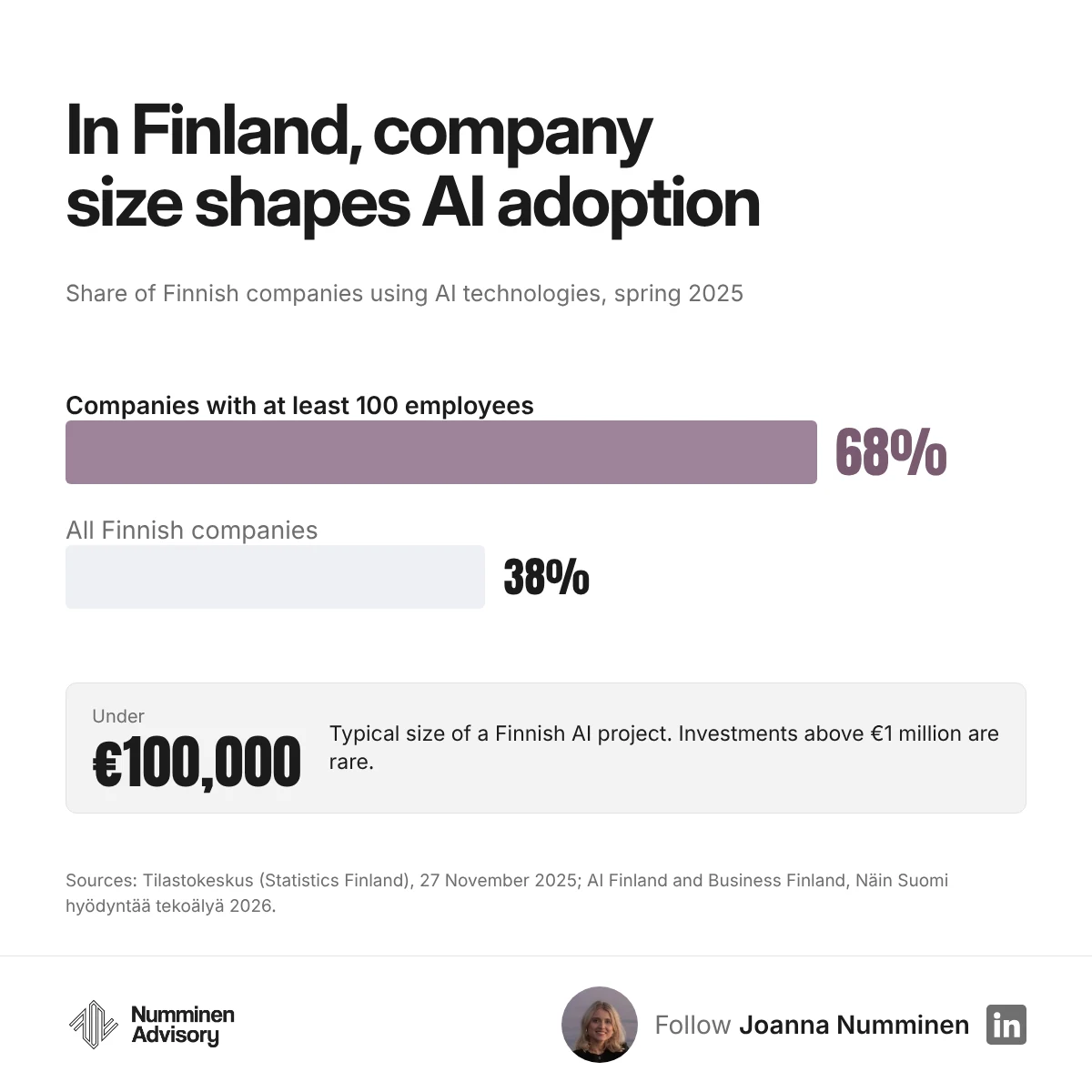
AI Finland and Business Finland describe two groups moving at different speeds. The number of advanced companies has more than quadrupled in two years, and more than half of organisations remain in evaluation and preparation.10 A typical Finnish AI project costs under €100,000, and investments above €1 million are rare.10
Deloitte’s State of AI in the Nordics 2026, based on 170 senior executives across Denmark, Finland, Norway and Sweden, adds a worrying trend. Strategic preparedness fell from 61% to 43% in a year, and talent preparedness sits at 14%.2 Only 5% report high expertise in agentic AI, and 49% expect agentic transformation to be more than three years away.2
Inside the finance function: Nordic CFOs and the global picture
Rillion’s Nordic Finance AI Report 2026 surveyed 250 CFOs and finance leaders. 8 in 10 already use AI in their daily work.3 Nearly half of Danish finance leaders report broad use of AI across the finance function, against 37% in Finland and 34% in Sweden.3
Large companies elsewhere report higher numbers. KPMG’s survey of 1,013 senior finance leaders at companies with revenues above US$250 million found that active AI use in the finance function has moved from 30% to 75% in two years.5 Protiviti’s 2026 survey of 902 finance executives puts it at 77% of finance groups.11
Use is one thing and results are another. Of those AI-using finance groups, only 14% have defined an AI strategy.11 In a Gartner survey of 183 CFOs, 84% of finance organisations have implemented or plan to implement AI, yet only 7% report a high or very high impact.12
The samples differ, so the comparison is indicative. Still, the Nordic gap to global leaders looks smaller once results enter the picture, because large international finance functions struggle to turn use into measurable value as well.
Where AI is creating value in finance
Much of the pitch for AI in finance has been about lower cost. The survey data describes something different. When Bain & Company asked CFOs to name their biggest AI win, speed and cycle-time reduction led at 48%, ahead of headcount or cost savings at 34%.4
KPMG’s findings point in the same direction. The largest improvements are in judgment work: decision-making quality (70%), decision-making speed (71%) and forecasting accuracy (64%).5 Transactional processes improve as well, by smaller margins.5 Forecasting is also where adoption has gone furthest, with 76% of AI-using finance groups applying it there.11
Across Nordic organisations as a whole, the gains so far are mostly in efficiency. For every organisation seeing revenue growth from AI, more than four report efficiency gains: 79% against 18%.2
What holds Nordic finance teams back
Data quality
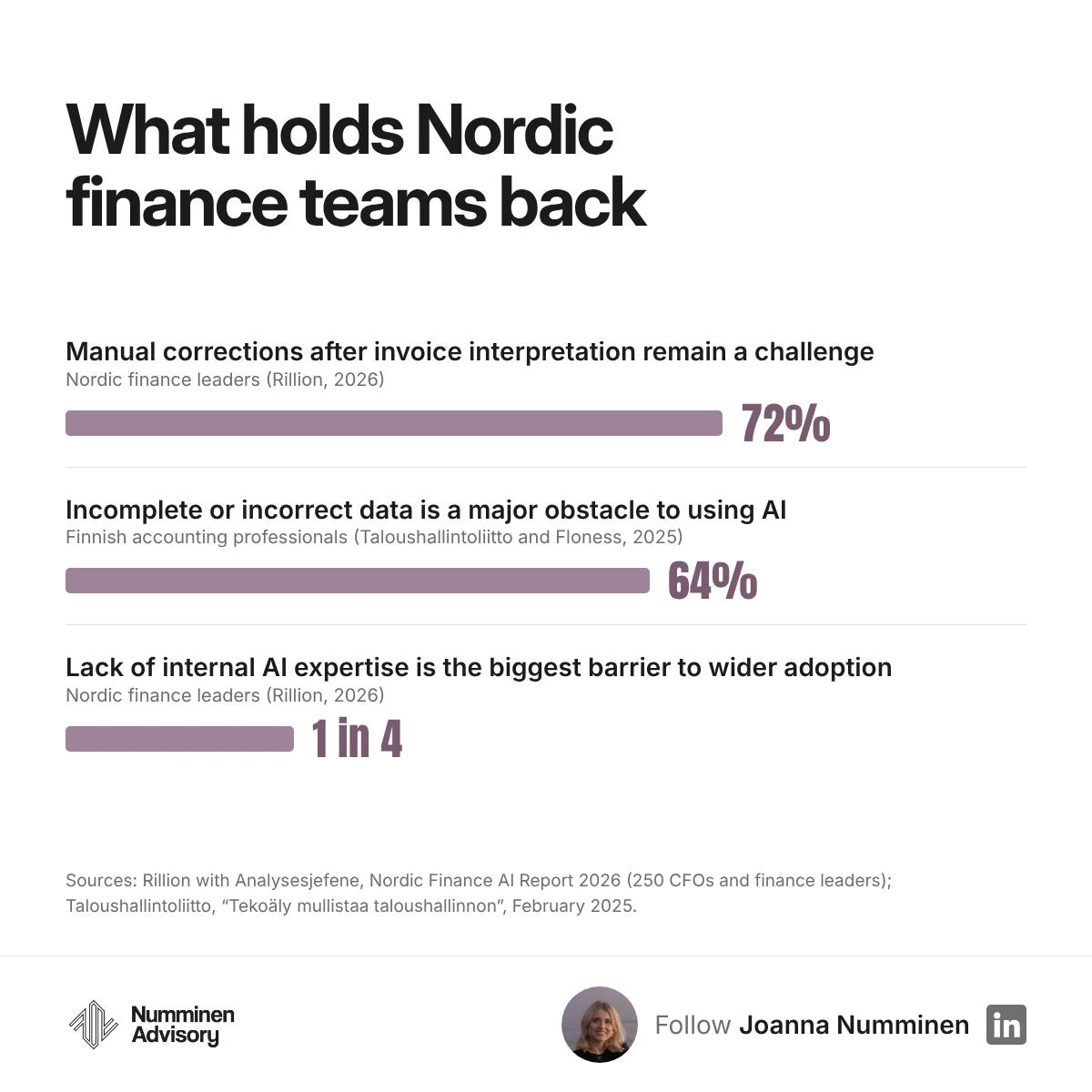
In a survey by Taloushallintoliitto and Floness of Finnish accounting professionals, 64% named incomplete or incorrect data as a major obstacle to using AI.6 Sentiment is strongly positive in the same group: 86% view AI adoption favourably and 84% expect significant time savings.6
Trust in the output
Among Nordic finance leaders, 72% say manual corrections after invoice interpretation remain a challenge.3 High confidence in AI for decisions is the exception, held by 1 in 5.3 International data shows what low trust costs. In an IDC survey of 2,275 senior finance decision makers in North America and EMEA for Sage, finance professionals spend nearly 13 hours every week reconstructing, validating and defending AI outputs.13 The same research shows 71% would reject an AI tool that is 99% accurate if it could not explain its answers.13
Appetite for autonomy has limits everywhere. Among the 1,434 finance leaders in Deloitte’s Finance Trends 2027 research, 77% are comfortable with AI agents making some autonomous decisions, but only 14% with fully autonomous agents for critical decisions.14
Skills
A quarter of Nordic finance leaders cite a lack of internal AI expertise as the biggest barrier to wider adoption.3 Together with Deloitte’s 14% talent preparedness figure, this puts capability at the top of the to-do list for most Nordic teams.2
Governance and the EU AI Act
For European finance teams, governance now comes with a legal deadline attached. PwC Finland’s study of 19 large Finnish companies found that 68% had an AI policy or equivalent guidance.15 The EU AI Act, in force since August 2024, had been assessed by a fifth of respondents.15 Three in four had piloted AI in finance, and the most common use was machine-learning-based purchase invoice processing, at 42%.15
Good governance pays off in performance. Organisations able to produce AI-related audit evidence efficiently report three to six times the rate of significant improvement compared with those that cannot, according to KPMG.5 On error reduction the split is 33% against 6%.5 Globally, only 42% of organisations are strongly assurance-ready for AI-enabled finance processes.5
Smaller companies: behind for now
Company size shapes adoption in the datasets that report it. In Finland, 68% of companies with at least 100 employees used AI in 2025, compared with 38% of all companies.7 The US CFO Survey run by Duke University and the Federal Reserve Banks of Richmond and Atlanta shows the same pattern: nearly 78% of large companies invested in AI during 2025, compared with 48% of small companies.16 CFOs there expect around 80% of small firms to invest in 2026.16
For a growth company, the gap is shrinking quickly. Because the tools are now widely available, a small finance team can reach the same starting point as a large one. What still separates companies is how clean the data is and how much trust the team puts in the outputs.
What this means for a Nordic finance leader
- Start with forecasting and planning. That is where adoption has gone furthest and where the largest improvements are reported.5, 11
- Fix the data your first use case depends on. Clean what feeds the forecast or the close, and leave the rest of the ledger for later.
- Decide what AI may do on its own and what it may only propose. Write it down. That record becomes the base for audit evidence and for your EU AI Act assessment.
- Measure the time you spend checking AI output. If validation eats the time the tool saves, the process needs redesign before the next tool.
- Invest in the team’s judgment. Nordic leaders name missing AI expertise as their biggest barrier, and that expertise includes knowing when to challenge an output.3
Frequently asked questions
How many Finnish companies use AI? According to Statistics Finland, 38% of Finnish companies used AI technologies in spring 2025, and 68% of companies with at least 100 employees did.7 Eurostat ranks Finland second in the EU at 37.8%.1
Are Nordic finance teams behind global peers on AI? Individually, Nordic CFOs are heavy users, with 8 in 10 using AI in their daily work.3 Across the finance function they trail large international companies: 37% of Finnish finance leaders report broad use, and 22% of Nordic organisations have moved 40% or more of their AI experiments into production.2, 3
What is the biggest obstacle to AI in finance in Finland? Incomplete or incorrect data comes first. In the Taloushallintoliitto survey, 64% of Finnish accounting professionals named incomplete or incorrect data as a major obstacle.6 Trust in outputs and a shortage of internal AI expertise follow.3
Where does AI deliver the most value in finance? In speed and judgment-heavy work. CFOs rank faster cycle times as their biggest AI win, and the largest reported improvements are in the quality of decisions and the accuracy of forecasts.4, 5
Numminen Advisory works with founders and finance teams of growing, internationally structured tech companies in Finland and Northern Europe. If you are deciding where AI fits in your finance function, let’s talk.
References
- Eurostat. 20% of EU enterprises use AI technologies. 11 December 2025.
- Deloitte. State of AI in the Nordics 2026. 8 April 2026.
- Rillion with Analysesjefene. Nordic Finance AI Report 2026. 2026.
- Bain & Company. CFOs Funded the AI Revolution. Now They’re Joining It. 12 April 2026.
- KPMG International. KPMG Global AI in Finance 2026: The Decision Advantage. May 2026, pp. 6, 7, 11, 14.
- Taloushallintoliitto. Tekoäly mullistaa taloushallinnon. 7 February 2025.
- Tilastokeskus (Statistics Finland). Tekoälyteknologioita käytti 38 % yrityksistä vuonna 2025. 27 November 2025.
- European Central Bank. Adoption and investment in AI across the euro area. Occasional Paper Series No 395, 2026, p. 6.
- Elinkeinoelämän keskusliitto EK. EK:n kysely: vain joka kymmenes yritys synnyttää uutta liiketoimintaa tekoälyllä. 2026.
- AI Finland and Business Finland. Näin Suomi hyödyntää tekoälyä 2026. 15 April 2026.
- Protiviti. 2026 Global Finance Trends Survey. August 2026, pp. 4, 9, 10.
- Gartner. Gartner Says CFOs Need Structured Finance AI Roadmaps. Press release, 8 June 2026.
- Sage. Finance Leaders Demand AI Transparency as 71% Reject Unexplained Decisions. Press release, July 2026.
- Deloitte. Finance Trends 2027. 8 September 2026.
- PwC Finland. PwC:n kyselytutkimus: tekoälyn hyödyntäminen suomalaisyritysten taloushallinnossa vielä maltillista. 3 February 2025.
- Duke University Fuqua School of Business. CFO Outlook for 2026: Tariffs, Hiring, Prices, and AI Impact. 17 December 2025.