



In brief
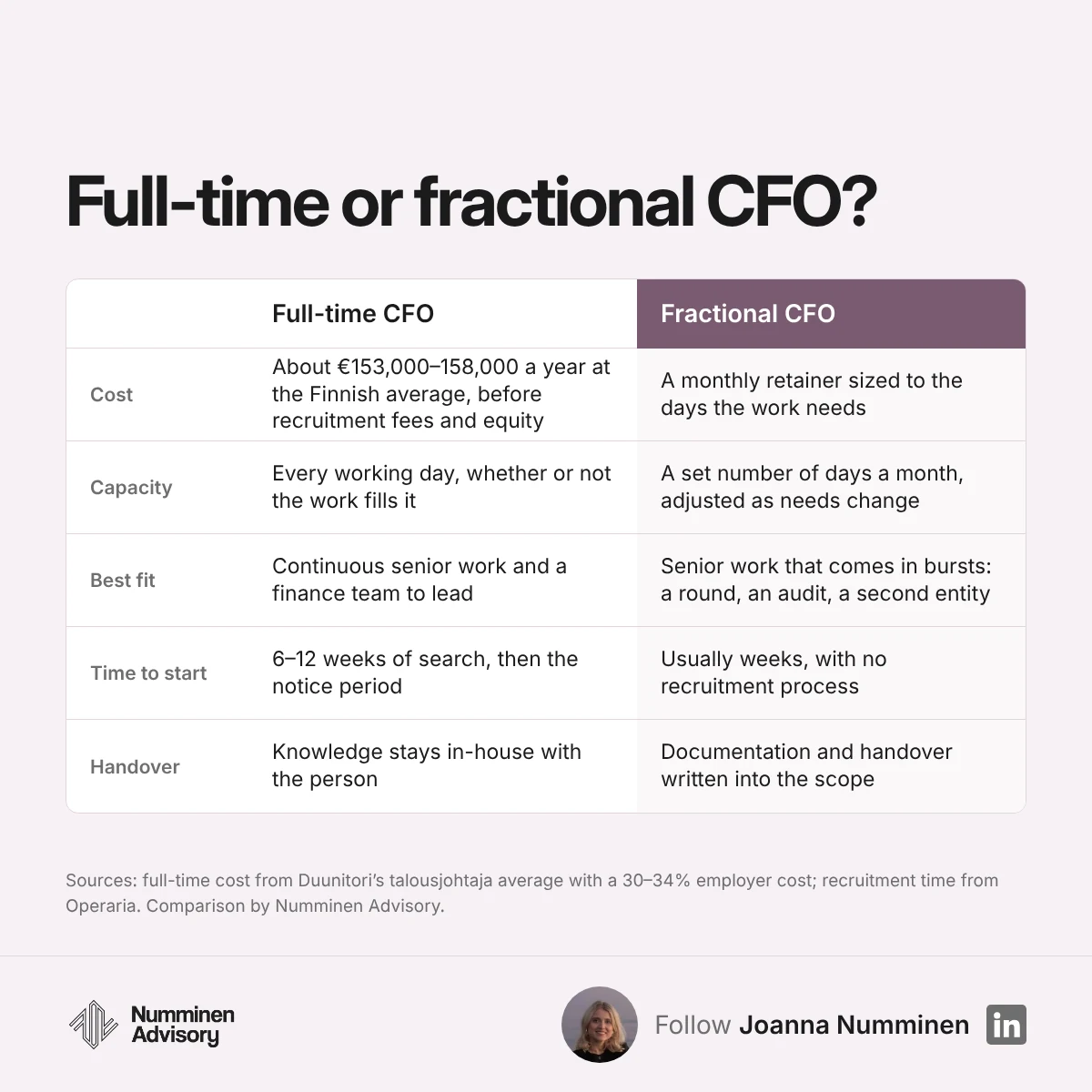
Before you hire: answer nine questions, from which decision you are making badly and whether your monthly close is reliable to which funding, audit, entity or grant trigger is within twelve months. The shape of the role: full-time when senior finance work fills every week, fractional when it is senior but intermittent, interim for a defined event with an end date. What is at stake: a full-time CFO in Finland costs roughly €153,000–158,000 a year with employer costs.
Before hiring a CFO, answer these nine questions honestly. Most of the time the hiring decision makes itself, and sometimes the answer turns out to be a project or a fractional arrangement.
I have looked at this decision from both sides of the table. Over more than 15 years I have built and led finance functions as an employee, from international finance operations at Groupon and Indeed.com to finance leadership at fast-growing startups such as Silo AI and ONEiO, and I have worked as the in-house CFO of a venture-backed scaleup. Today I work as a fractional CFO. Along the way I have seen CFO hires made too early, too late and for the wrong reasons, and these are the nine questions I would want a founder to answer before talking to any candidate, including me.
1. What decision are we currently making badly?
Name one specific decision, made in the last three months, that went the way it went because nobody could see the numbers clearly enough. Without one, the case for hiring rests on a feeling that finance ought to be better, which is a weaker basis than a problem.
2. Could our controller answer it if we asked better?
A surprising share of “we need a CFO” turns out to mean “we need our existing finance person pointed at different questions.” Asking costs a conversation. Hiring a full-time CFO at the Finnish average costs roughly €153,000–158,000 a year once employer costs are included (the calculation).
3. Is our monthly close reliable enough to build on?
It should land on a predictable date, with accruals, reviewed by someone before it is circulated. Fix that first when it doesn’t. Senior finance hired onto an unreliable close spends six months doing controller work at CFO cost and then leaves, because that is not the job they took. The order you build a finance function explains why.
4. Which trigger are we within twelve months of?
The four triggers are an institutional round, a first audit, a second country, and public funding large enough to carry real compliance exposure (more on each). If none is within a year, you are probably early. If two are, you are probably late.
5. Full-time, fractional or interim, and why that one?
Full-time fits when the work is continuous and large enough to fill a week. Fractional fits when the work is senior but intermittent, which describes most companies below about €10M in revenue. Interim fits a defined event with an end date. Defaulting to full-time because it is the familiar shape is how companies end up paying for capacity they cannot feed.
6. Who does this person report against?
What matters is what the person is measured against, and whether the board sees them directly. A CFO who only ever reaches the board through the CEO is a finance manager with a better title, and a good candidate will work this out during the process.
7. What does the role own in year one, written down?
List three to five things, each specific enough to verify. “Improve financial management” is too vague to check, whereas “Build a monthly group consolidation that closes by working day ten” can be checked. Until you can write the list, you are not ready to interview, because you have no way to tell a good candidate from a plausible one.
8. If we hire nobody, what breaks first, and when?
Give it a date. Sometimes the honest answer is that nothing breaks and things simply stay harder than they should be. That is a real answer, and the usual response to it is a project or a fractional arrangement.
9. What are we hoping this hire lets us stop worrying about?
This is the hardest one, and worth sitting with. When the answer is a category of work, the hire will probably deliver it. When it is the weight of the decisions themselves, the hire will leave that weight where it is. Runway appetite, when to raise, what to promise the board and when to stop funding something stay with the CEO regardless of who you hire. A CFO changes the quality of the information underneath those decisions, and the decisions remain yours.
Bottom line
A CFO hire should solve a named problem on a known timeline. Fix the close before you hire above it, tie the hire to a specific trigger, and write down what the role owns in year one before you meet anyone. Then choose the shape of the role deliberately: full-time when senior finance work fills every week, fractional when it is senior but intermittent, and interim when there is a defined event with an end date. At roughly €153,000–158,000 a year for a full-time CFO in Finland, that choice is the most expensive one on this list to get wrong. Finally, be honest about which part of the discomfort a hire can remove, because the hardest decisions stay with the CEO whoever you hire.