



In brief
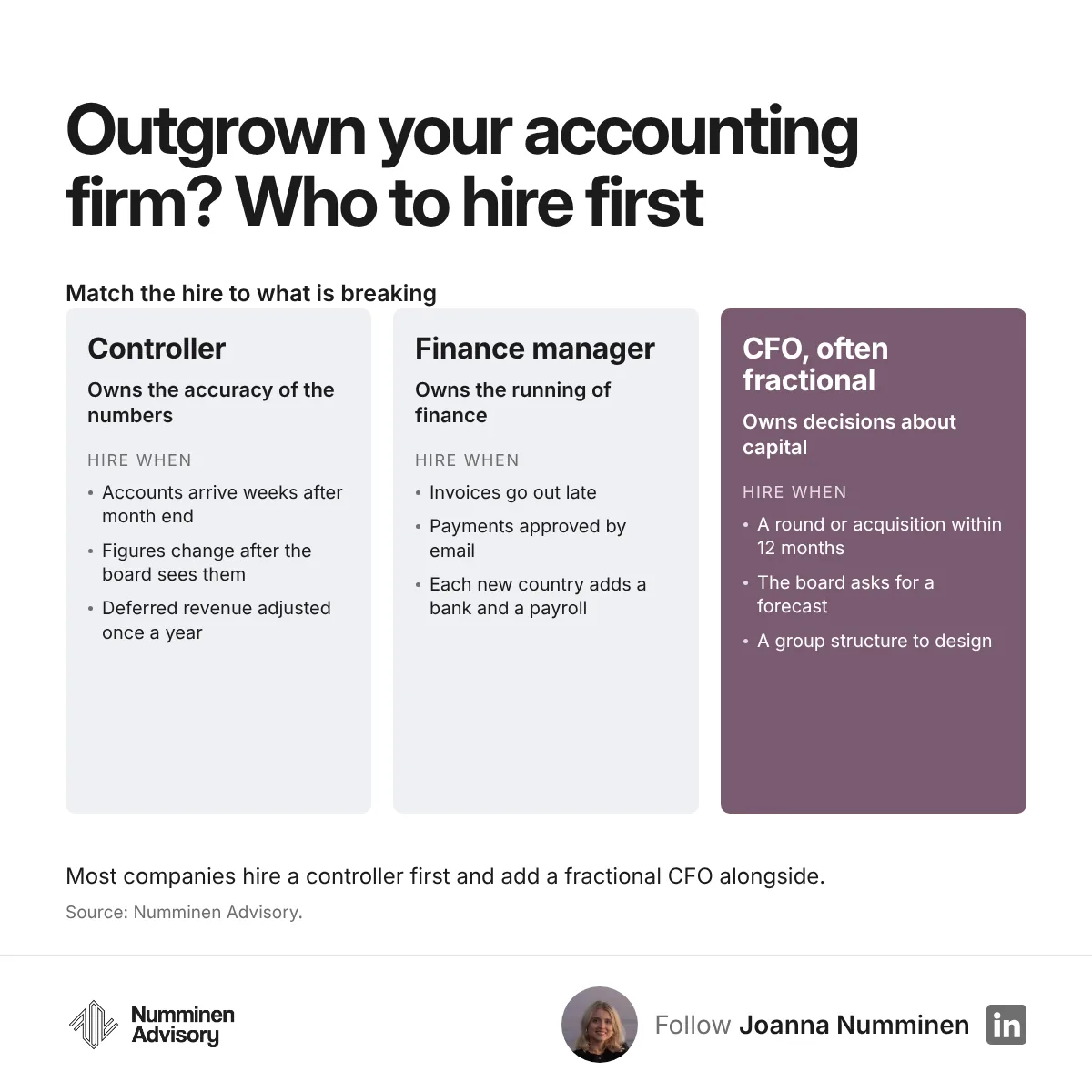
When a startup outgrows its accounting firm, the first internal finance hire should match what is breaking. A controller fixes a slow or unreliable monthly close. A finance manager takes over day-to-day finance administration across entities. A CFO is needed when the decisions are about capital: a funding round, a group structure or an acquisition. Most companies hire a controller first and bring in a fractional CFO alongside.
Most startups in Finland and the rest of Europe start the same way. An accounting firm keeps the books, runs payroll and files VAT, and the founder handles everything else in finance. It works well for a single entity with simple revenue. It stops working when the company raises institutional money, opens a subsidiary abroad, or signs customers on contracts that the accounting firm was never set up to interpret.
At that point the question becomes who to hire first. The answer depends on which part of the finance function is failing, and it is rarely the same for two companies.
Three roles that often get confused
The titles overlap, and in Finnish companies talouspäällikkö, controller and talousjohtaja are sometimes used for the same job. It helps to define them by what each one owns.
A controller owns the accuracy of the numbers. The monthly close, balance sheet reconciliations, accruals and deferred revenue, the chart of accounts and the internal controls around payments. A controller looks backwards and makes sure the books are right.
A finance manager owns the running of finance. Supplier invoices and payments, customer invoicing and collections, payroll inputs, expense policy, and the working relationship with the accounting firm and the bank. In a growing group this often includes keeping two or three entities’ administration in step.
A CFO owns decisions about capital. Where funding comes from and what it costs, how long the cash lasts, how the group is structured, what investors and the board see, and what has to be true before the next round or transaction. A CFO looks forward.
What breaks first when you outgrow the accounting firm
The symptoms are usually visible months before anyone names them. Matching the symptom to the role is the most reliable way to decide.
| What you are seeing | What is missing | Who fixes it |
|---|---|---|
| Management accounts arrive three or four weeks after month end, and the numbers change after the board has seen them | A monthly close owned inside the company | Controller |
| Deferred revenue, accruals and intercompany balances are adjusted once a year | Reconciliations and revenue accounting | Controller |
| Invoices go out late, suppliers chase payments and nobody owns the bank portal | Day-to-day finance operations | Finance manager |
| A second or third entity has its own accounting firm and nobody joins the pieces up | Group administration | Finance manager, with a controller for consolidation |
| A funding round, debt facility or acquisition is planned within twelve months | Capital decisions and investor readiness | CFO, often fractional |
| The board asks for a forecast and the founder builds it alone at night | Planning and runway ownership | CFO, often fractional |
Why the controller usually comes first
For a company leaving the accounting firm model, the controller is the most common first hire. Hire a CFO into a function without a reliable monthly close, and they spend the first months doing controller work at CFO cost. The wider sequence, from bookkeeping to FP&A, is covered in the order you build a finance function.
The accounting firm keeps the bookkeeping, payroll processing and statutory filings, often for years. What moves inside is ownership of the close and of how transactions are classified.
When a finance manager makes more sense
A finance manager is the better first hire when the books are broadly right but the operations around them are not. This is common in companies that grew quickly through sales, where invoicing lags behind and each new country adds a bank and a payroll provider. Payments are often still approved by email. Bringing order to that work also frees the founder’s time.
In a small team the two roles often merge into one person, a financial controller, who runs the operations and owns the close. The combination works well up to a point. Once there are several entities, more than one reporting framework or an audit to prepare for, the close work tends to crowd out everything else.
Where a CFO fits
A full-time CFO is a late hire for most startups. The decisions that need one arrive in bursts: a round, a new subsidiary, a first audit, a transaction. Between those events, the work of a CFO amounts to a few days a month. That is why many growth companies pair an internal controller or finance manager with a fractional CFO who owns the forecast, the board reporting and the funding work.
The triggers that call for a CFO are structural, not a revenue figure. A company with one entity and simple subscription revenue can grow a long way with a controller and a good accounting firm. A smaller company with three entities, public funding and investors asking for IFRS reporting usually cannot.
How AI changes the first hire
AI tools now prepare much of the routine work in a finance function, such as matching bank transactions, coding supplier invoices and drafting variance commentary. In practice that changes the profile of the first hire more than the number of hires. Someone who can set up and review automated reconciliations covers more ground than a person who does them by hand, and a small team can support a larger group. The judgement about what gets booked and what the board is told stays with people.
Bottom line
When you outgrow your accounting firm, look at what is failing before you write the job description. Late or unreliable numbers call for a controller. Chaotic day-to-day operations call for a finance manager. Decisions about capital call for a CFO, and at startup scale that is usually a fractional one working alongside the first internal hire. If you are unsure which applies, request an intro call and we will tell you, including when the answer is a controller rather than us.